[Data Insight] CHO resDNA Detection Kit: High Sensitivity and Specificity for Biologics QC
 Publication Date:2025-07-25
 Page Views:1574
In biopharmaceutical manufacturing, the detection of residual host cell DNA (HCD) is a critical quality control step to ensure product safety and efficacy. Among the various host cell lines used, Chinese hamster ovary (CHO) cells remain the most widely adopted due to their ease of cultivation, high productivity, and stable protein expression profiles. CHO cells are commonly employed in the production of monoclonal antibodies, recombinant proteins, and vaccines.
However, residual CHO DNA (resDNA) that remains after production can pose potential safety risks. Certain DNA sequences may elicit unwanted immune responses in patients, while active genetic fragments could potentially alter the safety or effectiveness of the final therapeutic. To mitigate these risks, regulatory authorities globally have designated HCD levels as a critical quality attribute (CQA) and require strict monitoring throughout product development and manufacturing.
To safeguard the quality and safety of biologics, international regulatory agencies have established strict limits on residual HCD content. For example, according to WHO and FDA guidelines:
• For standard biologics: HCD levels must be ≤100 pg per dose.
• For products derived from non-tumorigenic cells: HCD must be<10 ng/dose with DNA fragment length ≤200 bp.
• For high-dose biologics (e.g., monoclonal antibodies): a limit of ≤10 ng/dose may be acceptable, but a comprehensive risk assessment based on DNA source and route of administration is required.
Featured Product
To support the development and quality control of biopharmaceuticals, ACROBiosystems has launched a high-sensitivity CHO resDNA quantification kit (Cat. No. OPA-R004) specifically designed for CHO cell expression systems. Based on quantitative PCR (qPCR) technology, this kit enables rapid and accurate detection of residual DNA in in-process samples and drug substance, meeting the stringent requirements of biopharmaceutical manufacturers for CHO-derived resDNA monitoring.
Product Highlights
 High Sensitivity & Specificity – Accurately quantifies ultra-low levels of CHO resDNA with no cross-reactivity to non-target DNA.
Reliable Performance – Delivers excellent recovery rates, even in complex matrices and real production samples.
Outstanding Assay Quality – Rigorously validated, with superior performance compared to competing products.
Expert Support – Includes technical consultation and guidance for method transfer to ensure smooth implementation.
Eurofins Validated – Third-party Validation from Eurofins Available.
1. Performance Comparison
• Standard Curve and Amplification Efficiency
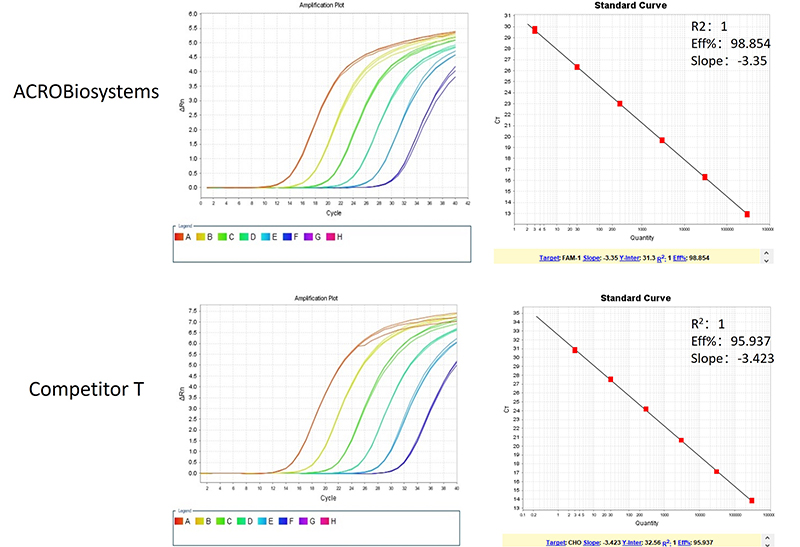
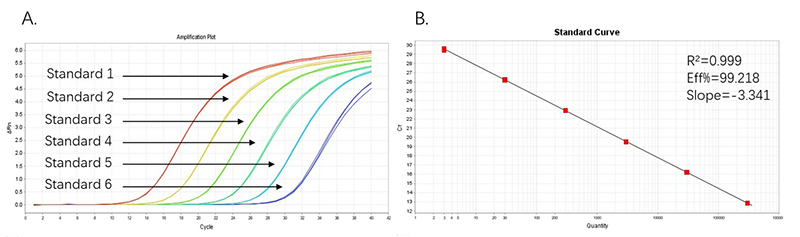
The CHO resDNA Quantitation Kit (qPCR) from ACROBiosystems delivers excellent performance in sensitivity and amplification efficiency. Experimental data show: R² = 0.999, Amplification efficiency (Eff%) = 100.1%, Slope = –3.318. These results fully comply with USP and EP guidelines and indicate strong performance in low-level CHO host cell DNA detection, outperforming some commercial alternatives in qPCR amplification efficiency.
• Consistent inter-batch performance
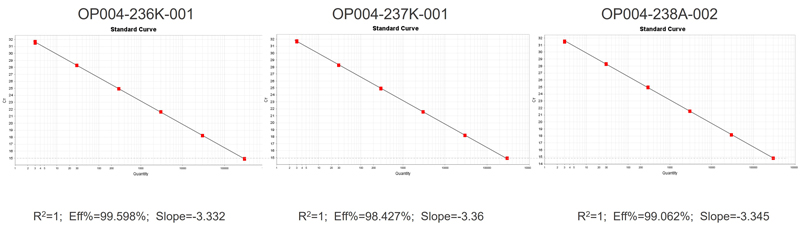
The standard curves of different batches of OPA-R004 kits were equal to 1, amplification efficiency (Eff%) ≈ 99%, and slope (slope) ≈ -3.3, all of which met the requirements of HCD qPCR detection.
• Specificity
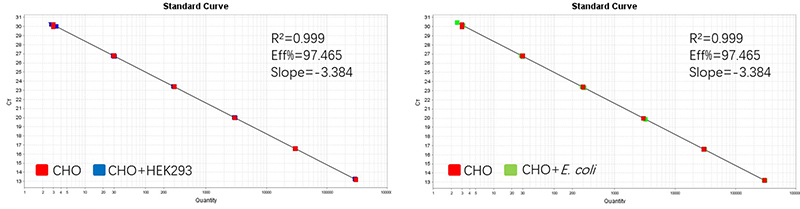
The CHO resDNA Quantitation Kit (qPCR) offers high assay specificity with no cross-reactivity. The standard curve is generated using 10-fold serial dilutions of CHO genomic DNA (included in the kit) and shows no signal from unrelated DNA sources.
• Linear Range & Sensitivity
This kit provides both high sensitivity and a broad dynamic range, with linear quantification across at least 6 orders of magnitude. The lower limit of quantification (LLOQ) reaches 3 fg/μL, enabling accurate detection of CHO DNA from high to extremely low concentrations—ideal for diverse QC applications.
2. Application Scenarios
• Detection in Complex Sample Matrices
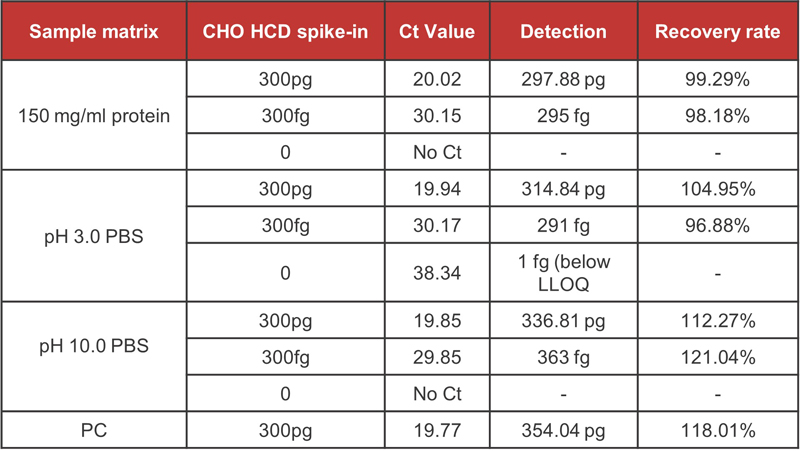
The CHO resDNA Quantitation Kit (qPCR) demonstrates excellent performance in complex sample matrices. When used with the resDNA Sample Preparation Kit (Magnetic Beads), it enables efficient DNA extraction and detection in high-protein matrices (up to 150 mg/mL) and across a wide pH range (3.0–10.0). Recovery rates remain consistent between 98% and 120%, highlighting the kit’s strong anti-interference capabilities.
• Detection in Real-World Samples
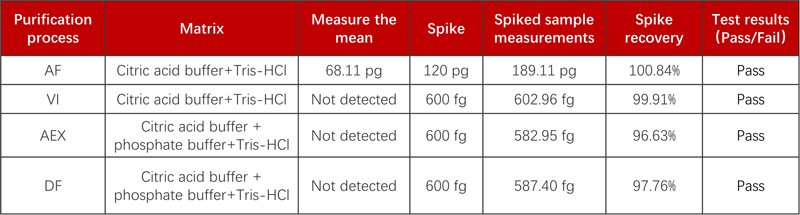
The kit also performs reliably with real process samples. During testing of antibody purification intermediates (e.g., AF, VI, AEX, DF) from CHO-based production, the combination of the CHO resDNA Quantitation Kit (qPCR) and resDNA Sample Preparation Kit (Magnetic Beads) enabled direct detection of residual DNA with spike recovery rates close to 100%. These results confirm the kit’s accuracy and robustness in real-world bioprocessing applications.
3. Technical Support & Platform Compatibility
ACROBiosystems offers comprehensive technical support and method transfer guidance to ensure smooth implementation of the CHO resDNA Quantitation Kit (qPCR). Our expert team is available to assist users with troubleshooting and protocol optimization.
The kit is also fully compatible with major qPCR platforms, including the Bio-Rad CFX96 Real-Time PCR System, allowing users to integrate it directly into existing workflows without the need for new instrumentation—saving both time and cost.
4. Conclusion
The CHO resDNA Quantitation Kit (qPCR) from ACROBiosystems delivers outstanding performance across key evaluation metrics—including standard curve linearity, amplification efficiency, recovery, reproducibility, specificity, broad linear range, and robustness in complex and real-world samples. Combined with strong technical support and platform compatibility, this kit provides a highly accurate and reliable solution for CHO host cell DNA detection, supporting quality and safety in biopharmaceutical production.
Related Recommendations
• E. coli resDNA Quantitative Kit (qPCR)
• HEK293T resDNA Quantitative Kit (qPCR)
• Universal Protein A Quick ELISA Kit (Boiling-free)
• Recombinant Factor C Endotoxin Detection Kit
• Request CMC Quality Control Kit Validation Report!
 Popular ArticlesRelated RecommendationsPopular Events
 Why CAR-T Works in Blood Cancers but Struggles in Solid Tumors2026-05-27Page Views:11
 Universal CAR Detection Solutions: Broad Compatibility, Higher Efficiency!2026-05-25Page Views:21
 Comprehensive Guide to CAR-T Targets in Solid and Hematologic Malignancies2026-05-21Page Views:155
 Bispecific Antibody Lanscape: Evolution, Breakthroughs, and Prospects2026-05-21Page Views:150
 CD19 as a CAR-T Target: Biology, Limitations, and Alternative Strategies2026-05-20Page Views:126





 Related Products