Save Product

Product Details
Synonym
CD7, GP40, TP41, LEU-9, Tp40
Source
APC-Labeled Human CD7 Protein, His Tag (CD7-HA2H3) is produced via conjugation of APC to Human CD7 Protein, His Tag with a new generation site-specific technology under optimal conditions with a proprietary technology. Human CD7 Protein, His Tag is expressed from human 293 cells (HEK293). It contains AA Ala 26 - Pro 180 (Accession # P09564-1).
Predicted N-terminus: Ala 26
Request for sequenceMolecular Characterization

Other Tags and Version Biotin & Other Labeled Version
This protein carries a polyhistidine tag at the C-terminus.
The protein has a calculated MW of 20.0 kDa.
Conjugate
APC
Excitation Wavelength: 640 nm
Emission Wavelength: 661 nm
Application
Please note that this product is NOT compatible to streptavidin detection system.
Formulation
Lyophilized from 0.22 μm filtered solution in PBS, 0.5% BSA, pH7.4 with trehalose as protectant.
Contact us for customized product form or formulation.
Reconstitution
Please see Certificate of Analysis for specific instructions.
For best performance, we strongly recommend you to follow the reconstitution protocol provided in the CoA.
Storage
For long term storage, the product should be stored at lyophilized state at -20°C or lower.
Please protect from light and avoid repeated freeze-thaw cycles.
This product is stable after storage at:
- -20°C to -70°C for 12 months in lyophilized state;
- -70°C for 3 months under sterile conditions after reconstitution.
ACRO Quality Management System
Customers Also Viewed
Performance Data
Bioactivity-FACS
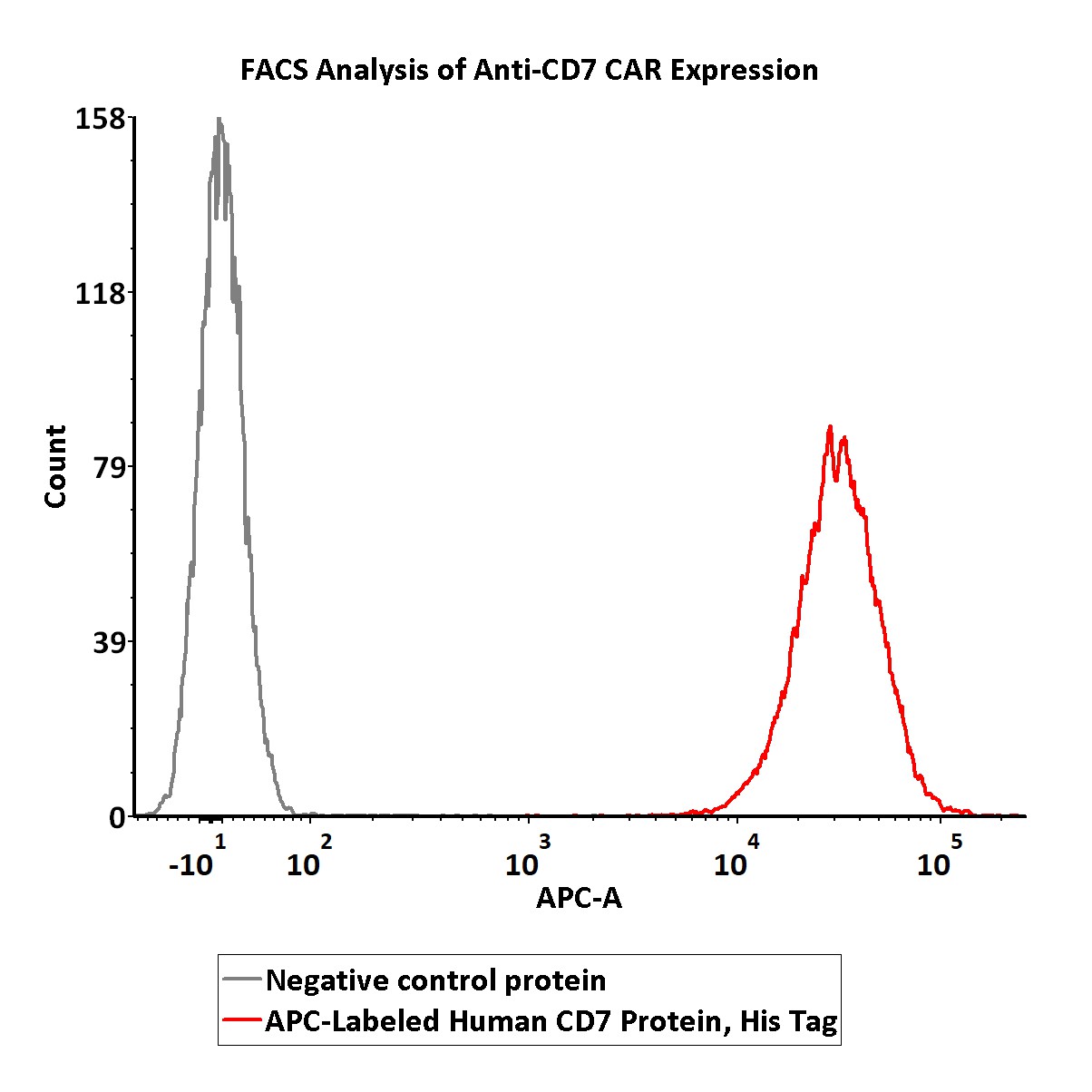
5e5 of anti-CD7 CAR-293 cells were stained with 100 μL of 1:25 dilution (4 μL stock solution in 100 μL FACS buffer) of APC-Labeled Human CD7 Protein, His Tag (Cat. No. CD7-HA2H3) and negative control protein respectively. APC signal was used to evaluate the binding activity (QC tested).
Protocol
Customer Reviews Writing Reviews

Background
Recent Advances
 Drug Development Progress
- English Name:
T-cell antigen CD7
- Category:
- Approved Drugs:
0 Details
- Drugs in Clinical Trials:
32 Details
- Highest Development Stage:
Phase 2 Clinical
 Contact Us


 Drug Candidate Licensing