Save Product

Product Details
Synonym
MMP7, Matrilysin, Matrin, MPSL1, PUMP1
Source
Human MMP-7, His Tag (MM7-H5249) is expressed from human 293 cells (HEK293). It contains AA Leu 18 - Lys 267 (Accession # P09237-1). It needs to be activated by agents such as APMA in vitro to have hydrolytic activity.
Predicted N-terminus: Leu 18
Request for sequenceMolecular Characterization

Other Tags and Version Biotin & Other Labeled Version
This protein carries a polyhistidine tag at the N-terminus.
The protein has a calculated MW of 30.0 kDa. The protein migrates as 30 kDa when calibrated against Star Ribbon Pre-stained Protein Marker under reducing (R) condition (SDS-PAGE) due to glycosylation.
Endotoxin
Less than 1.0 EU per μg by the LAL method / rFC method.
Purity
>90% as determined by SDS-PAGE.
Formulation
Supplied as 0.2 μm filtered solution in 10 mM HEPES,150 mM NaCl,pH7.5 with glycerol as protectant.
Contact us for customized product form or formulation.
Shipping
This product is supplied and shipped with dry ice, please inquire the shipping cost.
Storage
Please avoid repeated freeze-thaw cycles.
This product is stable after storage at:
- The product MUST be stored at -70°C or lower upon receipt;
- -70°C for 3 months under sterile conditions.
ACRO Quality Management System
Customers Also Viewed
Performance Data
SDS-PAGE
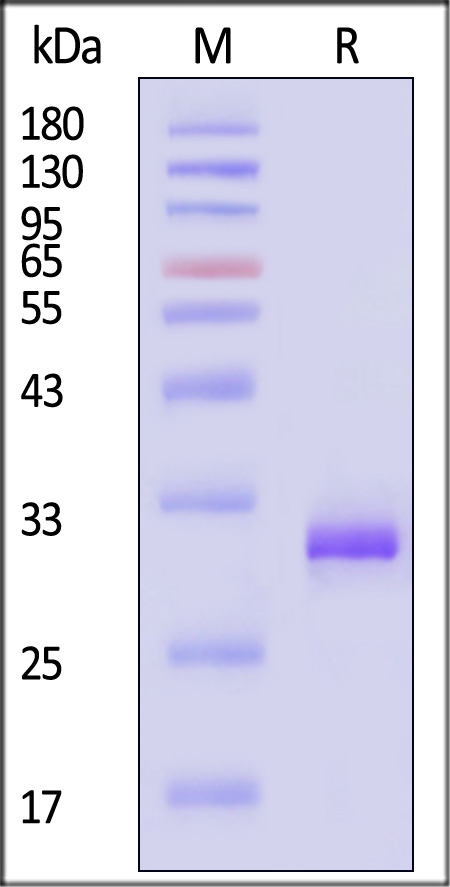
Human MMP-7, His Tag on SDS-PAGE under reducing (R) condition. The gel was stained with Coomassie Blue. The purity of the protein is greater than 90% (With Star Ribbon Pre-stained Protein Marker).
Bioactivity-ELISA
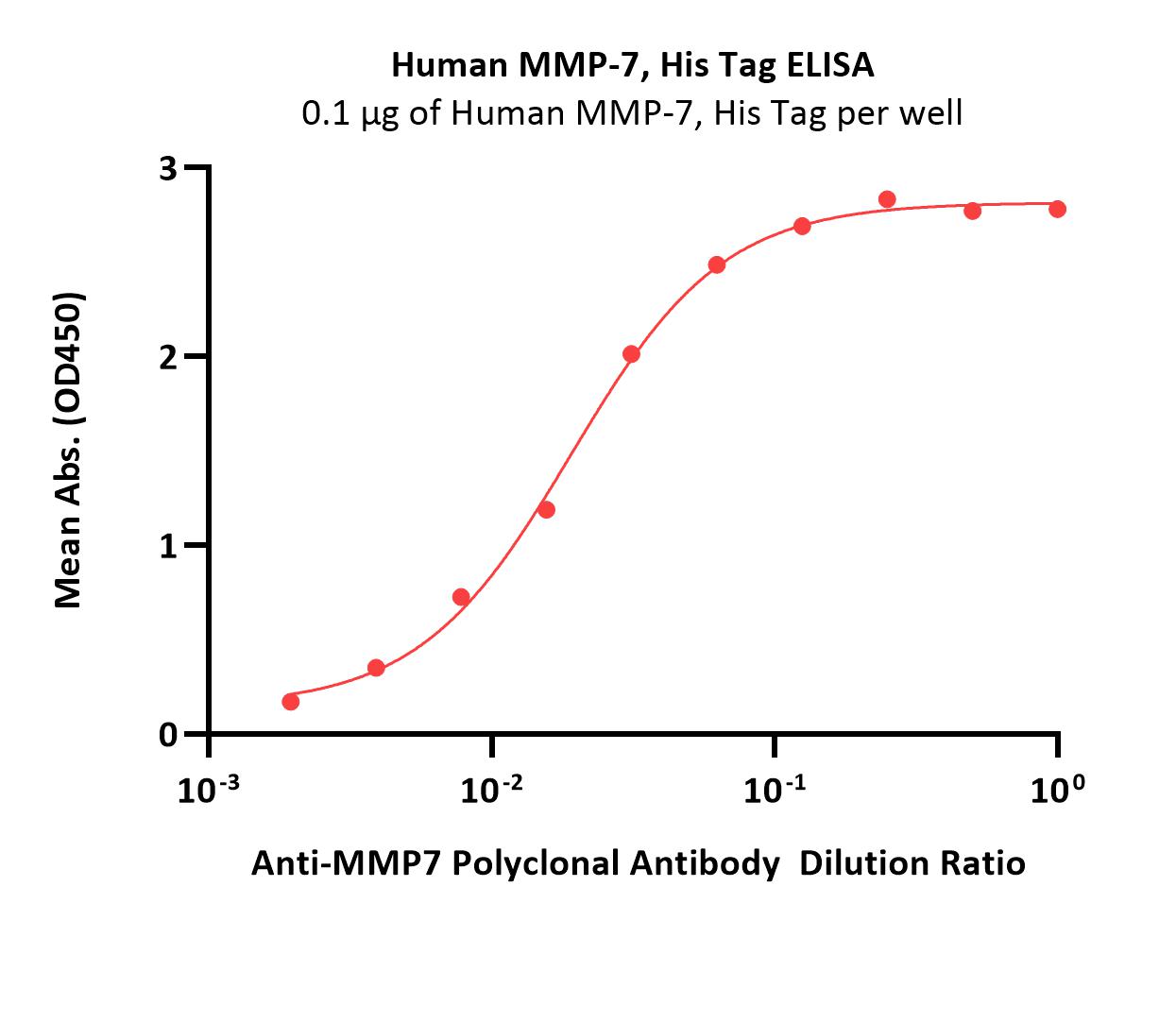
Immobilized Human MMP-7, His Tag (Cat. No. MM7-H5249) at 1 μg/mL (100 μL/well) can bind various dilution ratio of Anti-MMP7 Polyclonal Antibody (Routinely tested).
Protocol
Bioactivity
Measured by its ability to cleave the fluorogenic peptide substrate Mca-PLGL-Dpa-AR-NH2. The specific activity is >600 pmol/min/μg (QC tested).
Protocol
Customer Reviews Writing Reviews

Background
Recent Advances
 Drug Development Progress
- English Name:
Matrilysin
- Category:
- Approved Drugs:
0 Details
- Drugs in Clinical Trials:
1 Details
- Highest Development Stage:
Phase 2 Clinical
 Contact Us


 Drug Candidate Licensing