
ELISA Solutions: High-Performance Buffers and Coated Plates

In ELISA assays, where precision and data reliability are critical, researchers often encounter challenges such as elevated background signals, suboptimal standard curve linearity, and complex assay workflows. These issues are frequently attributed to variations in buffer composition and the quality of key reagents. Even minor inconsistencies can substantially affect assay sensitivity, specificity, and reproducibility. To overcome these obstacles, we have developed a comprehensive range of ELISA buffers and coated plates, providing stable, high-performance solutions that ensure consistent results across both routine and specialized applications.

Buffers

In ELISA assays, critical steps such as blocking, washing, and sample dilution depend on robust and reliable buffers. Our optimized ELISA buffer effectively blocks non-specific binding sites on microplates, substantially reducing background signals and enhancing the assay’s signal-to-noise ratio. Each component is rigorously validated for compatibility to ensure seamless performance across all assay steps, supporting a broad dynamic range and excellent reproducibility. Furthermore, our dilution buffer is specifically formulated to minimize non-specific adsorption—including serum-induced background—thereby maximizing signal clarity and detection sensitivity.
Product List
Cat. No. Product Description Order Now
EBS-001 ELISA Buffer Set-96T

Order

EBS-002 ELISA Buffer Set (Phosphate system, 96T)

Order

DB-02 Dilution Buffer (Strengthen Blocking)

Order

Application Data
Validated by ELISA, the Dilution Buffer effectively reduces serum-derived background signals in SARS-CoV-2 Spike RBD detection

Validated by ELISA, the Dilution Buffer effectively reduces serum-derived background signals in SARS-CoV-2 Spike RBD detection

2% serum diluted by Dilution Buffer (Cat.No. DB-02 ): Biotinylated SARS-CoV-2 S protein RBD was put into, the background value is 2.383 and 2.148; 2% serum diluted by DB-02: Biotinylated SARS-CoV-2 S protein RBD was put into, the background value is 0.262 and 0.263. In the existence of DB-02, the serum background values significantly decreased. Note: Dilution Buffer is Wash Buffer with 0.5% (w/v) bovine serum albumin (BSA), 50 mL.

Request Protocol

Coated Plates

  • Streptavidin Coated Plates
  • Nickel-Coated Plates

Streptavidin Coated Plates

Designed for applications based on the biotin–streptavidin interaction, our Streptavidin-Coated Plates provide a convenient and reliable platform for assay development. The high-density streptavidin coating enables efficient and specific capture of biotinylated molecules while minimizing non-specific binding and background signals. By eliminating traditional plate-coating steps, these plates streamline workflow setup and improve experimental consistency. They offer a flexible solution for a wide range of applications, including ELISA, protein interaction analysis, and high-throughput target-binding studies.
Product List
Cat. No. Product Description Order Now
SP-11 Streptavidin Coated Plates, Clear, 12×8-Well Strips, White Frame

Order

SP-13 Streptavidin Coated Plates, Clear, 12×8-Well Strips, White Frame (For Serological Testing)

Order

SP-14 Streptavidin Coated Plates, Clear, 96-Well, Clear Frame

Order

SP-15 Streptavidin Coated Plates, Clear, 96-Well, Clear Frame (For Serological Testing)

Order

Application Data
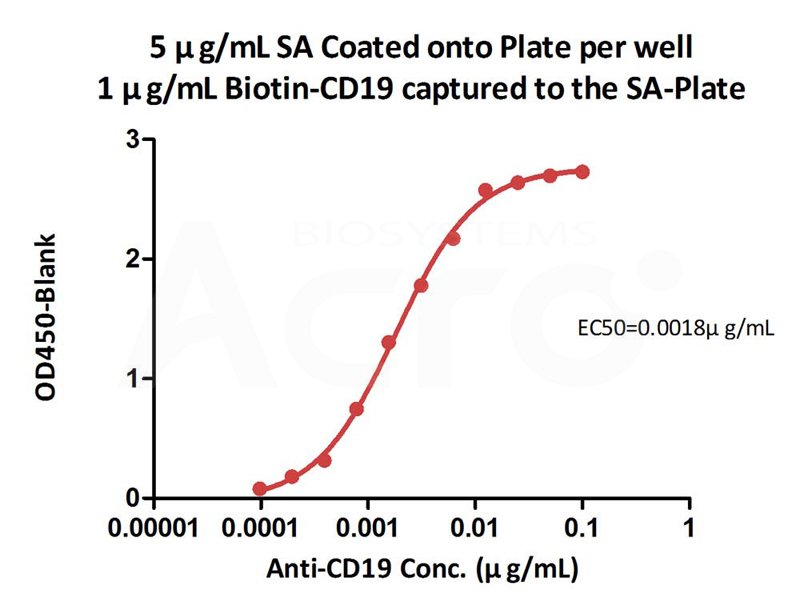
Streptavidin coated plates: suitable for evaluating the binding activity between CD19 protein and anti-FMC63 antibody

Streptavidin coated plates: suitable for evaluating the binding activity between CD19 protein and anti-FMC63 antibody

Immobilized Biotinylated Human CD19 (20-291), His, Avitag (Cat. No. CD9-H82E9) at 1 μg/mL (100 μL/well) on Streptavidin Coated Plates, Clear, 12×8-Well Strips, White Frame (Cat. No. SP-11), can bind Anti-FMC63 antibody with a linear range of 0.1-3 ng/mL (Routinely tested).

Request Protocol
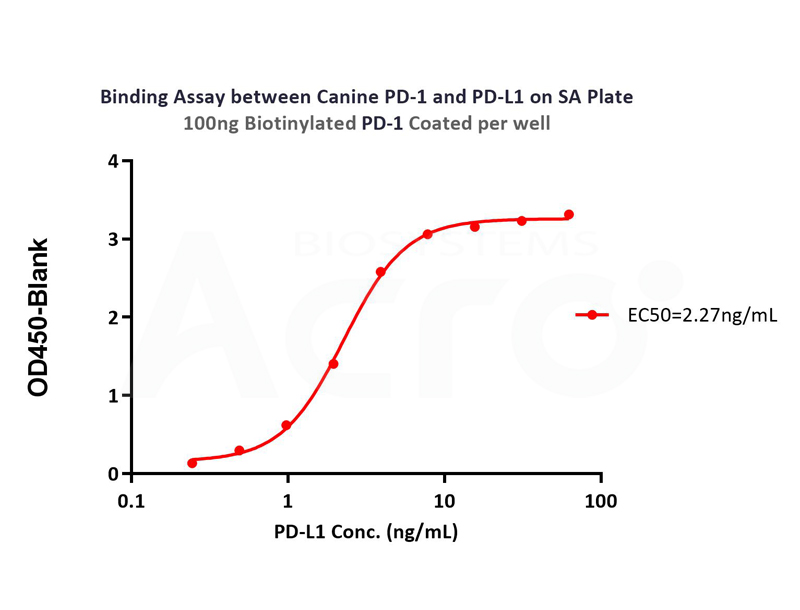
Streptavidin coated plates: suitable for evaluating the binding activity between PD-1 and PD-L1

Streptavidin coated plates: suitable for evaluating the binding activity between PD-1 and PD-L1

Immobilized Biotinylated Canine PD-1, His&Avi tag at 1000ng/mL (100 μL/well) on Streptavidin Coated Plates, Clear, 96-Well, Clear Frame (For Serological Testing) (Cat. No. SP-15), can bind PD-L1 with a linear range of 0.244-62.5ng/mL, EC50=2.27ng/mL (QC tested).


Request Protocol

Nickel-Coated Plates

In ELISA assays, critical steps such as blocking, washing, and sample dilution depend on robust and reliable buffers. Our optimized ELISA buffer effectively blocks non-specific binding sites on microplates, substantially reducing background signals and enhancing the assay’s signal-to-noise ratio. Each component is rigorously validated for compatibility to ensure seamless performance across all assay steps, supporting a broad dynamic range and excellent reproducibility. Furthermore, our dilution buffer is specifically formulated to minimize non-specific adsorption—including serum-induced background—thereby maximizing signal clarity and detection sensitivity.
Product List
Cat. No. Product Description Order Now
SP-19 Nickel Coated Plates, Clear, 12×8-Well Strips, White Frame

Order

Application Data
Nickel-coated plates: suitable for evaluating the binding activity between Siglec-10 protein and anti-Siglec-10 antibody

Nickel-coated plates: suitable for evaluating the binding activity between Siglec-10 protein and anti-Siglec-10 antibody

Immobilized Cynomolgus Siglec-10, His Tag at 1 μg/mL (100 μL/well) on Nickel Coated plates, Clear, 12×8-Well Strips (Cat.No. SP-19), can bind Anti-Cynomolgus Siglec-10 Antibody, Human IgG1 with a linear range of 0.005-0.313 μg/mL, CV% of Intra-assay tests<10% (QC tested).

Request Protocol
Nickel-coated plates: suitable for assessing the binding activity between GLP1R protein and anti-GLP1R antibody

Nickel-coated plates: suitable for assessing the binding activity between GLP1R protein and anti-GLP1R antibody

Immobilized Human GLP1R Full Length Protein (L260F), Flag,His Tag at 5 μg/mL (100 μL/well) on Nickel Coated plates, Clear, 12×8-Well Strips (Cat.No. SP-19), the binding activity with Monoclonal Anti-GLP1R Antibody, Fc Tag (A6727) was the similar with the other nickel plate.

Recommended Products

ComboX

FAQ

Q

How do I choose the right ELISA buffer for my assay?

Choose the buffer according to the specific step and requirements of your ELISA workflow. ACROBiosystems offers ELISA buffer sets for routine assay workflows and a strengthened blocking dilution buffer (Cat. No. DB-02) designed to reduce non-specific adsorption and serum-derived background.
Q

How can I reduce high background signals in my ELISA assay?

High background can be influenced by non-specific binding, sample matrix effects, and suboptimal blocking, washing, or dilution conditions. Optimized ELISA buffers can help minimize non-specific interactions and improve the signal-to-noise ratio. ACROBiosystems DB-02 Dilution Buffer has been validated to significantly reduce serum-derived background in an ELISA-based SARS-CoV-2 Spike RBD detection system.
Q

When should I use a strengthened blocking dilution buffer?

A strengthened blocking dilution buffer can be useful when sample matrices, such as serum, contribute to elevated non-specific background. DB-02 is formulated with enhanced blocking capability to minimize non-specific adsorption and improve signal clarity and detection sensitivity.
Q

When should I use a streptavidin-coated plate for my assay?

Streptavidin-coated plates are suitable when your assay requires efficient immobilization of biotinylated molecules. They provide a ready-to-use solid phase based on the high-affinity biotin-streptavidin interaction, eliminating traditional plate-coating steps and helping improve workflow consistency.
Q

How do I choose between strip-format and 96-well streptavidin-coated plates?

Select the plate format according to your assay scale and workflow. ACROBiosystems offers clear 12 × 8-well strip plates (SP-11 and SP-13) for flexible use of individual strips and clear 96-well plates (SP-14 and SP-15) for standard full-plate workflows. SP-13 and SP-15 are specifically offered for serological testing applications.
Q

Can streptavidin-coated plates be used for protein-protein or protein-antibody binding assays?

Yes. Streptavidin-coated plates can immobilize biotinylated proteins for subsequent binding assays. For example, SP-11 has been validated using biotinylated human CD19 to evaluate binding to an anti-FMC63 antibody, while SP-15 has been validated in a biotinylated PD-1/PD-L1 binding assay.
Q

What are the advantages of using pre-coated streptavidin plates instead of coating plates in-house?

Pre-coated streptavidin plates eliminate the need for traditional coating steps and provide a convenient platform for capturing biotinylated molecules. The high-density streptavidin coating supports efficient and specific capture while helping minimize non-specific binding and background, simplifying assay setup and improving experimental consistency.
Q

What should I consider if my ELISA shows poor signal-to-background performance?

Review the blocking, washing, and sample dilution conditions, as each can affect non-specific binding and assay sensitivity. When serum or other complex sample matrices contribute to background, an optimized dilution buffer with strengthened blocking capability may improve signal clarity. For biotin-based assays, the immobilization conditions of biotinylated molecules on streptavidin-coated plates should also be optimized for the specific assay system.
  • ELISA Solutions: High-Performance Buffers and Coated Plates
  • Buffers
  • Coated Plates
  • Recommended Products
  • FAQ