
Mon panier

Monoclonal Anti-Human 4-1BB Antibody, Mouse IgG1, premium grade

  • GMP version GMP-M41B35 is now available for seamless transition.
Avis des utilisateurs
Numéro de produit/spécification
Prix
Qté
Premium grade liquid
41B-CH25G1-100ug
$160.00
41B-CH25G1-1mg (500ug X 2)
$430.00
GMP liquid
GMP-M41B35-500ug
$1500.00
GMP-M41B35-2.5mg (500ug X 5)
$5000.00
ETA of in-stock products:2 business days
Total des articles Montant du produit$ 0

Détails du produit

  • Features and Advantages

    1. Seamless Transition from Preclinical to Clinical: Same cell clone, process, and QC as GMP products.
    2. Enhanced Production Standards: AOF raw materials, pharma-grade excipients, Grade B+A (ISO 5) environment.
    3. Comprehensive Quality Control: Additional strict testing for process impurities, sterility, and mycoplasma.
    4. Cost-Effective Solution: GMP-comparable quality at an economical price for early development.
    5. Risk Mitigation: Enhanced safety through rigorous impurity control and comprehensive testing.
  • Source

    Monoclonal Anti-Human 4-1BB Antibody, Mouse IgG1, premium grade (41B-CH25G1) is a chimeric monoclonal antibody recombinantly produced from CHO cells, which combines the variable region of a human monoclonal antibody with mouse IgG1 constant domain.

    It is produced under our rigorous quality control system that incorporates a comprehensive set of tests including sterility and endotoxin tests. Product performance is carefully validated and tested for compatibility for cell culture use or any other applications in the early preclinical stage.
    GMP-M41B35 is the GMP version of this 41B-CH25G1. These two proteins display indistinguishable performance profiles, thereby ensuring a seamless transition for end users from early preclinical stage to later clinical phases.

  • Isotype

    Mouse IgG1, Kappa

  • Specificity

    This product is a specific antibody specifically reacts with 4-1BB.

  • Endotoxin

    Less than 0.002 EU per μg by the LAL method / rFC method.

  • Protein A

    <5 ppm of protein tested by ELISA.

  • Host Cell Protein

    <0.5 ng/μg of protein tested by ELISA.

  • Host Cell DNA

    <0.02 ng/μg of protein tested by qPCR.

  • Purity

    >95% as determined by SDS-PAGE.

    >95% as determined by SEC-MALS.

  • Sterility

    Negative

  • Mycoplasma

    Negative

  • Formulation

    Supplied as 0.2 μm filtered solution in PBS, pH7.4 with trehalose as protectant.

    Contact us for customized product form or formulation.

  • Shipping

    This product is supplied and shipped with dry ice, please inquire the shipping cost.

  • Storage

    For long term storage, the product should be stored at liquid state at -20°C or below.

    Please avoid repeated freeze-thaw cycles.

    This product is stable after storage at:

    1. -20°C or below for 24 months under sterile conditions;
    2. 2-8°C for 12 months after thaw if within expiry date.
  • ACRO Quality Management System

    1. QMS(ISO, GMP)
    2. Quality Advantages
    3. Quality Control Process
  • Quality Description

    ACRO's Research-grade products are suitable for a wide range of cell culture applications, particularly for research use in academic institutions. These products are sterilized by filtration, followed by lyophilization where applicable. Typical specifications include endotoxin levels of <0.01 EU/μg and purities >95%. Biological activity is calibrated against WHO/NIBSC standards when available.
    ACRO's Premium-grade (Pre-GMP) products are characterized by their high quality and enhanced safety profiles, making them ideal for early-stage discovery and manufacturing processes in cell therapy companies. A key advantage is their seamless transition to corresponding GMP-grade versions. Biological activity is calibrated against WHO/NIBSC standards when available. Typical specifications include endotoxin levels of <0.01 EU/μg and purities >95%. In addition, rigorous testing is conducted to ensure the absence of mycoplasma, HCD, and HCP, thereby guaranteeing product safety.

Les clients ont également consulté

Affichage des données

  • SDS-PAGE

    4-1BB SDS-PAGE

    Monoclonal Anti-Human 4-1BB Antibody, Mouse IgG1, premium grade on SDS-PAGE under reducing (R) and non-reducing (NR) conditions. The gel was stained with Coomassie Blue. The purity of the protein is greater than 95% (With Star Ribbon Pre-stained Protein Marker).

  • SEC-MALS

    4-1BB SEC-MALS

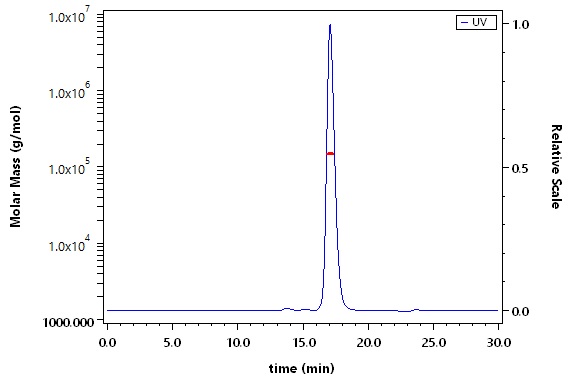
    The purity of Monoclonal Anti-Human 4-1BB Antibody, Mouse IgG1, premium grade (Cat. No. 41B-CH25G1) is more than 95% and the molecular weight of this protein is around 135-165 kDa verified by SEC-MALS.

    Report
  • Bioactivity-CELL BASE

     4-1BB CELL

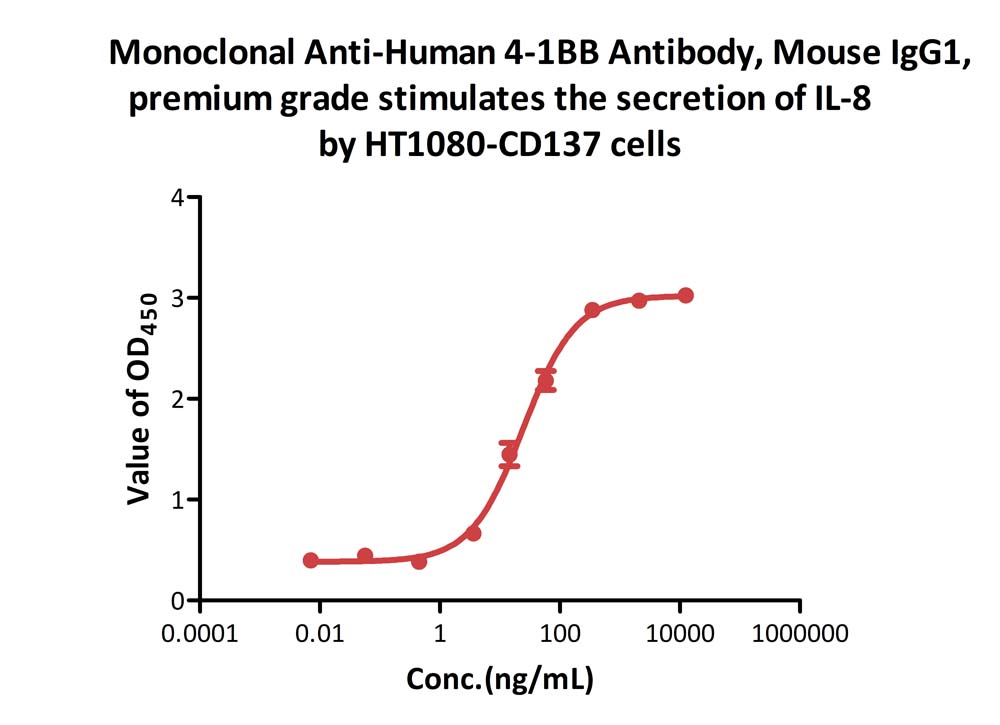
    Monoclonal Anti-Human 4-1BB Antibody, Mouse IgG1, premium grade (Cat. No. 41B-CH25G1) stimulates the secretion of IL-8 by HT1080 human CD137 cell line. The typical EC50 for this effect is 24.29 ng/mL (QC tested).

    Protocol
  • Bioactivity-ELISA

     4-1BB ELISA

    Immobilized Human 4-1BB, His Tag (Cat. No. 41B-H52Hc) at 1 μg/mL (100 μL/well) can bind Monoclonal Anti-Human 4-1BB Antibody, Mouse IgG1, premium grade (Cat. No. 41B-CH25G1) with a linear range of 0.1-2 ng/mL (QC tested).

    Protocol
  • Bioactivity-Stability

     4-1BB STABILITY

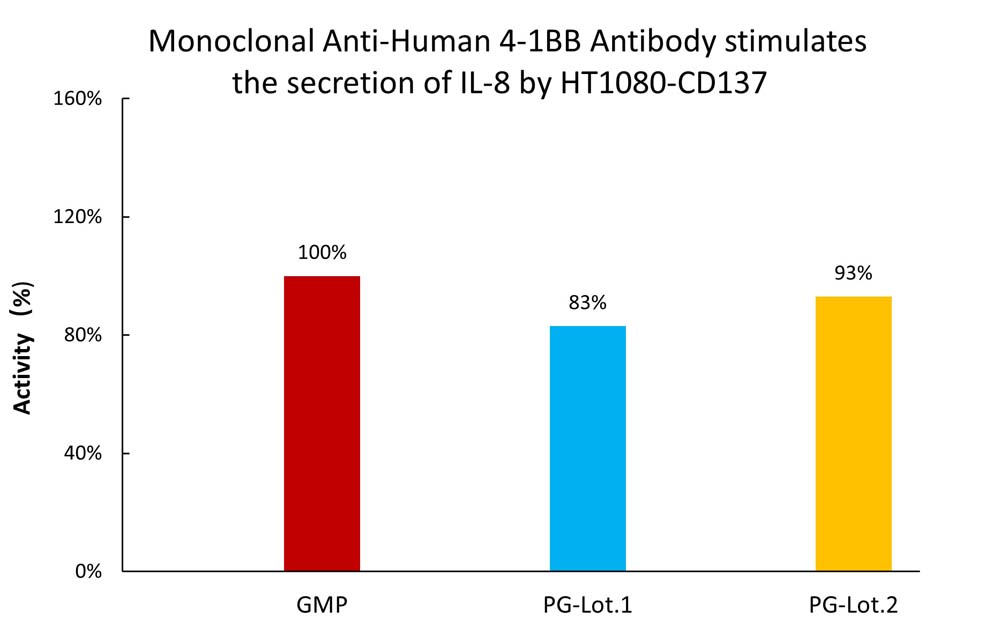
    Cell-based assay demonstrates batch-to-batch consistency between Acro's GMP and PG Anti-Human 4-1BB Antibody.

Avis des utilisateurs
Publier un commentaire

Introduction de fond

4-1BB, also known as CD137 and TNFRSF9, is an approximately 30 kDa transmembrane glycoprotein in the TNF receptor superfamily. 4-1BB functions in the development and activation of multiple immune cells. Mature human 4-1BB consists of a 163 amino acid (aa) extracellular domain (ECD) with four TNFR cysteine-rich repeats, a 27 aa transmembrane segment, and a 42 aa cytoplasmic domain . Within the ECD, human 4-1BB shares 60% aa sequence identity with mouse and rat 4-1BB. 4-1BB is expressed as a disulfide-linked homodimer on various populations of activated T cell including CD4, CD8, memory CD8, NKT, and regulatory T cells as well as on myeloid and mast cell progenitors, dendritic cells, mast cells, and bacterially infected osteoblasts . It binds with high affinity to the transmembrane 4-1BB Ligand/TNFSF9 which is expressed on antigen presenting cells and myeloid progenitor cells . This interaction costimulates the proliferation, activation, and/or survival of the 4-1BB expressing cell . It can also enhance the activation-induced cell death of repetitively stimulated T cells . Mice lacking 4-1BB show augmented T cell activation, perhaps due to its absence on regulatory T cells . 4-1BB can associate with OX40 on activated T cells, forming a complex that responds to either ligand and inhibits Treg and CD8 T cell proliferation . Reverse signaling through 4-1BB Ligand inhibits the development of dendritic cells, B cells, and osteoclasts but supports mature dendritic cell survival and costimulates the proliferation and activation of mast cells.
4-1BB activation enhances CD8 T cell and NK cell mediated anti-tumor immunity . It also contributes to the development of inflammation in high fat diet-induced metabolic syndrome . Soluble forms of 4-1BB and 4-1BB Ligand circulate at elevated levels in the serum of rheumatoid arthritis and hematologic cancer patients, respectively .

Progrès de frontière

 
Progrès du développement médicamenteux
  • Nom anglais:

    Tumor necrosis factor receptor superfamily member 9

  • Catégorie:

  • Nombre de médicaments répertoriés:

    0 Détails

  • Nombre de médicaments cliniques:

    77 Détails

  • Étape de développement la plus élevée:

    Phase 3 Clinical

Drug Candidate Licensing
More
  • Informations de base sur le produit
  • Détails du produit
  • Les clients ont également consulté
  • Affichage des données
  • Avis des utilisateurs
  • Contexte