






 COA
- Détails du produit
- Affichage des données
- Reviews & Citations
- Resources
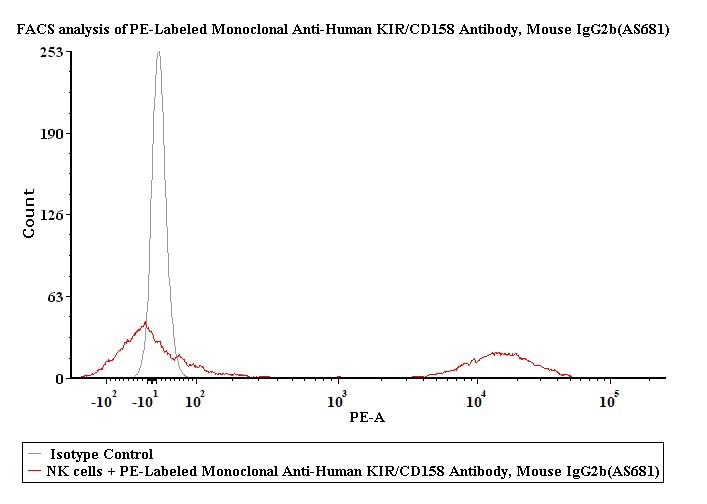
1/1



Monoclonal Anti-Human KIRCD158 Antibody, Mouse IgG2b(AS681) is a mouse monoclonal antibody, which provides higher batch consistency and long term security of supply.
AS681
Mouse IgG2b, Kappa
Mouse
Human
KIRCD158
PE
Excitation Wavelength: 488 nm / 561 nm
Emission Wavelength: 575 nm
This product is a specific antibody specifically reacts with KIRCD158 epsilon protein.
Application | Recommended Use |
Flow Cytometry | 1:20 |
* Recommended dilutions are for reference only. Optimal working concentrations may vary depending on your consumables, reagents, and assay conditions. We recommend optimizing for your specific system. No warranty is made regarding performance at any specific dilution.
The isotype control is sold separately; please refer to Cat. No. DNP-PM486 for product information.
Please refer to the Certificate of Analysis (CoA).
Liquid
Supplied a 0.22 μm-filtered solution in PBS (pH 7.4) containing 0.03% ProClin 300 and 0.2% BSA, with trehalose as protectant.
Please contact us for customized product forms or formulations.
Liquid product is shipped at blue ice.
Please protect from light and avoid repeated freeze-thaw cycles.
Product Specific Notices: For research use only.