

Détails du produit
- Genetically modified cell lines best reflect MOA (Mechanism of Action)
- Higher activity and larger assay window for robust and reproducible cell-based bioassay
- Comprehensive application data to support assay development and validation
- Full tracible record, stringent quality control and validated cell passage stability
- Parental cell line legally obtained from internationally recognized cell resource bank and commercially licensed
- Global commercial license assistance whenever regulatory filing is required
Description
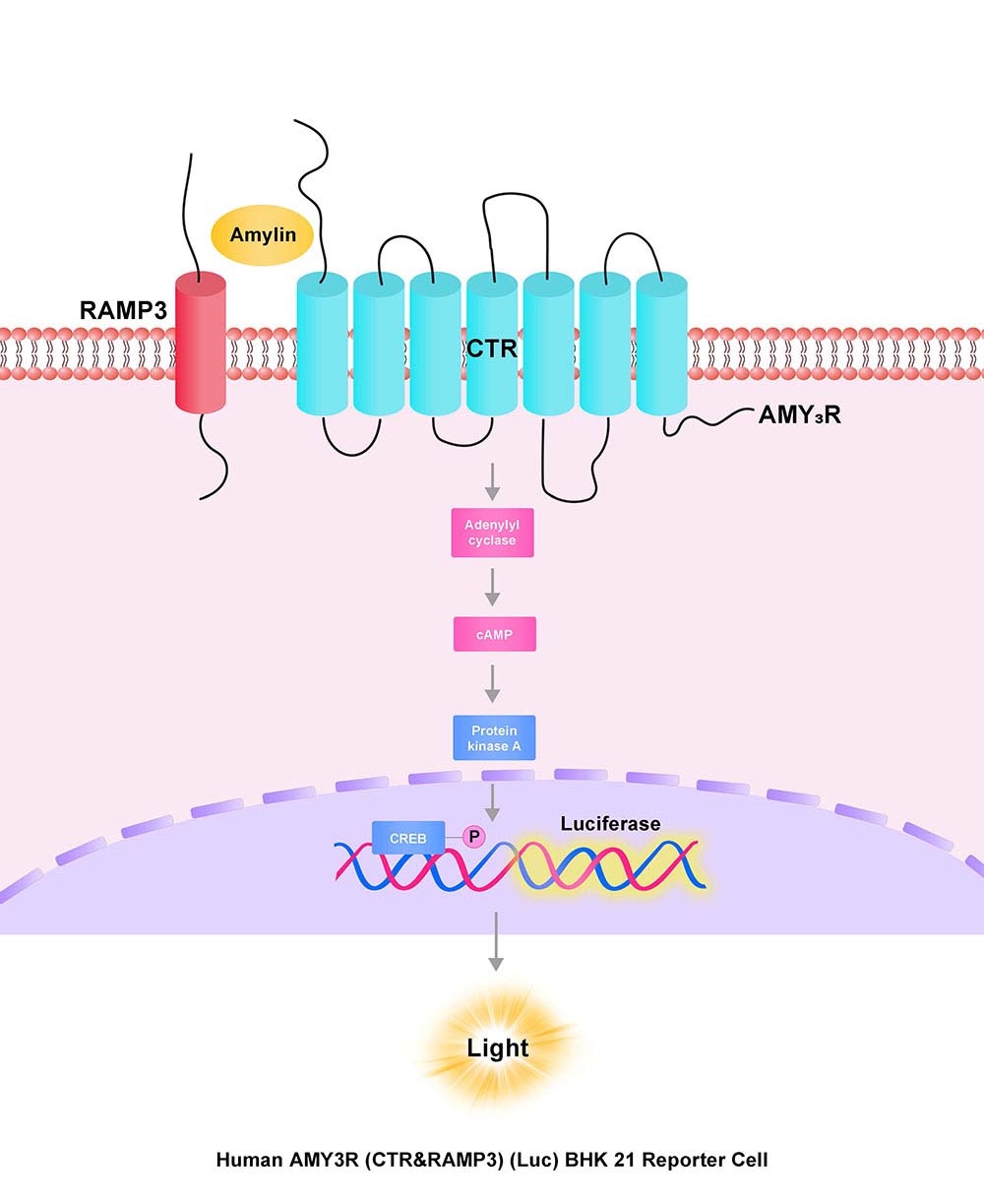
The Human AMY3R (CTR&RAMP3) (Luc) BHK 21 Reporter Cell was engineered to not only express CREB signaling response element, but also express the human AMY3R generated by co-expressing the full length human calcitonin receptor (CTR) (Uniprot: P30988-2) and the full length human receptor activity-modifying protein 3 (RAMP3) (Uniprot: O60896) added with an mGFP tag, which can drive luciferase expressing systems by amylin receptor (AMYR) agonists or amylin stimulation. In the absence of agonist or amylin, the AMY3R receptor is not activated and luminescence signal is low. In the presence of agonist or amylin, the AMY3R pathway-activated luminescence can be detected in a dose-dependent manner.
Application
• Screen for AMYR agonists that can bind and activate AMY3R.
Growth Properties
Adherent
Selection Marker
Puromycin (2 μg/mL) + Hygromycin B (20 μg/mL) + Zeocin (20 μg/mL)
Complete Growth Medium
DMEM + 10% FBS
Freeze Medium
Serum-free cell cryopreservation medium
Quantity
1 vial contains at least 5×10^6 cells in 1 mL serum-free cryopreservation medium
Storage
Frozen in liquid nitrogen.
Mycoplasma Testing
Negative
Sterility Testing
Negative
Instructions for Use
See data sheet for detailed culturing and assay protocol.
ACRO Quality Management System
Les clients ont également consulté
Affichage des données
Receptor Assay

Expression analysis of human CTR on Human AMY3R (CTR&RAMP3) (Luc) BHK 21 Reporter Cell by FACS.
Cell surface staining was performed on Human AMY3R (CTR&RAMP3) (Luc) BHK 21 Reporter Cell or negative control cell using anti-human CTR antibody followed by staining with APC anti-mouse IgG antibody.Protocol
Expression analysis of human receptor activity-modifying protein 3 (RAMP3) on Human AMY3R (CTR&RAMP3) (Luc) BHK 21 Reporter Cell by FACS.
Surface expression of human RAMP3 on Human AMY3R (CTR&RAMP3) (Luc) BHK 21 Reporter Cell was confirmed by detection of mGFP (FITC) using flow cytometry.Protocol
Application

Bioactivity analysis of human AMY3R agonist (RLU).
The Human AMY3R (CTR&RAMP3) (Luc) BHK 21 Reporter Cell and the parental Human CTR (Luc) BHK 21 Reporter Cell (Cat. No. SCBHK-ATF230) was incubated with serial dilutions of human Amylin. The EC50 of human Amylin determined on the Human AMY3R (CTR&RAMP3) (Luc) BHK 21 Reporter Cell was approximately 0.13 nM, and on the Human CTR (Luc) BHK 21 Reporter Cell was approximately 6.07 nM. The fold change (EC50 [Human CTR (Luc) BHK 21 Reporter Cell] / EC50 [Human AMY3R (CTR&RAMP3) (Luc) BHK 21 Reporter Cell]) was approximately 46.69, demonstrating that human Amylin was selective for human AMY3R over human CTR.Protocol
Bioactivity analysis of human AMY3R agonist (RLU).
The Human AMY3R (CTR&RAMP3) (Luc) BHK 21 Reporter Cell and the parental Human CTR (Luc) BHK 21 Reporter Cell (Cat. No. SCBHK-ATF230) was incubated with serial dilutions of Cagrilintide. The EC50 of Cagrilintide determined on the Human AMY3R (CTR&RAMP3) (Luc) BHK 21 Reporter Cell was approximately 0.09 nM, and on the Human CTR (Luc) BHK 21 Reporter Cell was approximately 0.16 nM. The fold change (EC50 [Human CTR (Luc) BHK 21 Reporter Cell] / EC50 [Human AMY3R (CTR&RAMP3) (Luc) BHK 21 Reporter Cell]) was approximately 1.77, demonstrating that Cagrilintide was non-selective for human AMY3R over human CTR.Protocol
Signaling Bioassay

Response to human Amylin (RLU).
This Human AMY3R (CTR&RAMP3) (Luc) BHK 21 Reporter Cell was incubated with serial dilutions of human Amylin. The EC50 was approximately 0.13 nM.Protocol
Response to human Amylin (FOLD).
This Human AMY3R (CTR&RAMP3) (Luc) BHK 21 Reporter Cell was incubated with serial dilutions of human Amylin. The max induction fold was approximately 19.09.Protocol
Avis des utilisateurs Publier un commentaire

Déclaration importante
Limited Use&License Disclosure
BY USE OF THIS PRODUCT, RESEARCHER AGREES TO BE BOUND BY THE FOLLOWING TERMS OF LIMITED USE OF THIS CELL LINE PRODUCT.
- If the researcher is not willing to accept the terms of limited use of this cell line product, and the product is unused, ACRO will accept return of the unused product.
- Researchers may use this product for research use only, no commercial use is allowed. "Commercial use" means any and all uses of this product and derivatives by a party for profit or other consideration and may include but is not limited to use in: (1) product manufacture; and (2) to provide a service, information or data; and/or resale of the product or its derivatives, whether or not such product or derivatives are resold for use in research.
- This cell line is neither intended for any animal or human therapeutic purposes nor for any direct human in vivo use. You have no right to share, modify, transfer, distribute, sell, sublicense, or otherwise make the cell line available for use to other researchers, laboratories, research institutions, hospitals, universities, or service organizations.
- ACROBIOSYSTEMS MAKES NO WARRANTIES OR REPRESENTATIONS OF ANY KIND, EITHER EXPRESSED OR IMPLIED, WITH RESPECT TO THE SUITABILITY OF THE CELL LINE FOR ANY PARTICULAR USE.
- ACROBIOSYSTEMS ACCEPTS NO LIABILITY IN CONNECTION WITH THE HANDLING OR USE OF THE CELL LINE.
- Modifications of the cell line, transfer to a third party, or commercial use of the cell line may require a separate license and additional fees. Please contact order@acrobiosystems.com for further details.