
Human CXCL14 Protein, His Tag

Numéro de produit/spécification
Prix
Availability
Qté
CX4-H5143-100ug
$360.00
In Stock - Order by 4 PM ET for overnight delivery on Nov. 16, 2026.
CX4-H5143-1mg (200ug X 5)
$2,380.00
In Stock - Delivery in 2 weeks
Montant du produit:
$ 0
0
Ajouter au panier
  • Détails du produit
  • Affichage des données
  • Reviews & Citations
  • Important Statement
  • Resources
Synonyms

BMAC, BRAK, KEC, KS1, MIP-2g, MIP2G, NJAC, SCYB14

Source

Human CXCL14 Protein, His Tag (CX4-H5143) is expressed from E. coli cells. It contains AA Ser 35 - Glu 111 (Accession # O95715).

Predicted N-terminus: Met

Molecular Characterization

This protein carries a polyhistidine tag at the N-terminus.

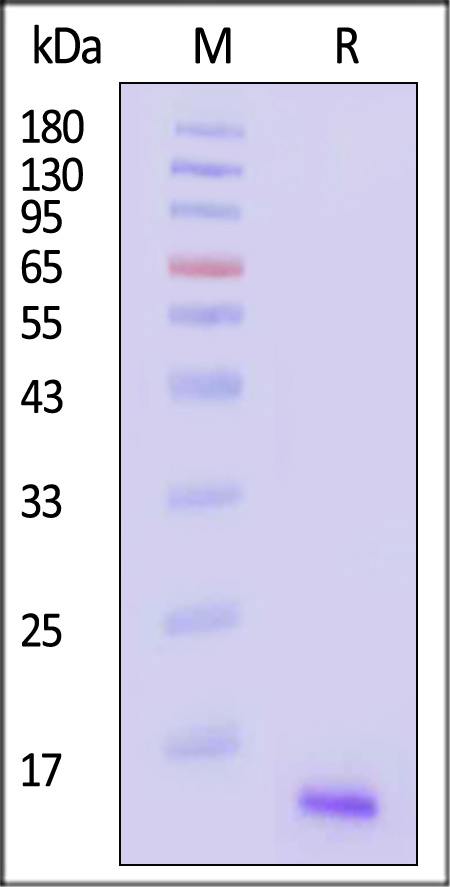
The protein has a calculated MW of 11.4 kDa. The protein migrates as 15 kDa when calibrated against Star Ribbon Pre-stained Protein Marker under reducing (R) condition (SDS-PAGE).

Purity

>90% as determined by SDS-PAGE.

Formulation

Lyophilized from 0.22 μm filtered solution in 0.5 M NaCl, 0.5 M Arginine, pH7.4 with trehalose as protectant.

Contact us for customized product form or formulation.

Reconstitution

Please see Certificate of Analysis for specific instructions.

For best performance, we strongly recommend you to follow the reconstitution protocol provided in the CoA.

Shipping and Storage

This product is shipped at ambient temperature.

For long term storage, the product should be stored at lyophilized state at -20°C or lower.

Please avoid repeated freeze-thaw cycles.

This product is stable after storage at:
  • -20°C to -70°C for 12 months in lyophilized state;
  • -70°C for 3 months under sterile conditions after reconstitution.

Introduction de fond

This antimicrobial gene belongs to the cytokine gene family which encode secreted proteins involved in immunoregulatory and inflammatory processes. The protein encoded by this gene is structurally related to the CXC (Cys-X-Cys) subfamily of cytokines. Members of this subfamily are characterized by two cysteines separated by a single amino acid. This cytokine displays chemotactic activity for monocytes but not for lymphocytes, dendritic cells, neutrophils or macrophages. It has been implicated that this cytokine is involved in the homeostasis of monocyte-derived macrophages rather than in inflammation.

ACRO Scientific Leadership Award

Supporting the scientists driving cell & gene therapy forward

Apply Now