


Rhesus macaque IL-18 Protein, Tag Free (MALS & SPR verified)

AIDD‑Ready
Cat. No. / Size
Price
Availability
Qty
IL8-R5113-100ug
$350.00
In Stock - Delivery in 1-2 business days
IL8-R5113-1mg (200ug X 5)
$2,310.00
In Stock - Delivery in 1-2 business days
IL8-R5113
Sub-Total :
$ 0
Customize Product Request Quote
Contact Us
Contact Us
Sub-Total:
$ 0
  • Product Details
  • Performance Data
  • Reviews & Citations
  • Important Statement
  • Resources
Synonyms

IL-18, Interleukin-18, IL18, IL-1 gamma, IGIF, IL1F4, IL-1F4

Source

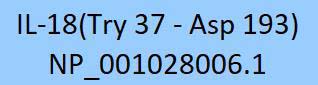
Rhesus macaque IL-18 Protein, Tag Free (IL8-R5113) is expressed from E. coli cells. It contains AA Try 37 - Asp 193 (Accession # NP_001028006.1).

Predicted N-terminus: Try 37
Molecular Characterization

This protein carries no "tag".

The protein has a calculated MW of 18.3 kDa. The protein migrates as 15-17 kDa when calibrated against Star Ribbon Pre-stained Protein Marker under reducing (R) condition (SDS-PAGE).

Endotoxin

Less than 1.0 EU per μg by the LAL method / rFC method.

Purity

>90% as determined by SDS-PAGE.

>90% as determined by SEC-MALS.

Formulation

Lyophilized from 0.22 μm filtered solution in PBS, pH7.4 with trehalose as protectant.

Contact us for customized product form or formulation.

Reconstitution

Please see Certificate of Analysis for specific instructions.

For best performance, we strongly recommend you to follow the reconstitution protocol provided in the CoA.

Shipping and Storage

This product is shipped at ambient temperature.

For long term storage, the product should be stored at lyophilized state at -20°C or lower.

Please avoid repeated freeze-thaw cycles.

This product is stable after storage at:
  • -20°C to -70°C for 12 months in lyophilized state;
  • -70°C for 3 months under sterile conditions after reconstitution.

Background

Interleukin-18 (IL-18) is a potent proinflammatory cytokine that induces interferon-gamma (IFN-gamma) production from Th1 cells, NK cells and activated macrophages, particularly in the presence of IL-12. IL-18 also functions in developmental regulation of T-lymphocyte helper type I cells and in Fas-mediated cytotoxicity. Suppression of IL-18 activity is being investigated for treatment of chronic inflammatory diseases such as Crohn's disease and rheumatoid arthritis. It acts by inducing heterodimerization of the two subunits of its receptor, IL-18RAlpha and IL-18RBeta shows structural similarity to IL-1.