Cat. No. / Size
Price
Availability
Qty
MCM-C52H3-100ug
$360.00
MCM-C52H3-1mg
$2,615.00
Sub-Total:
$ 0
  • Performance Data
  • Reviews & Citations
  • Important Statement
  • Resources
  • Synonyms

    MCAM, CD146, MUC18

  • Source

    Cynomolgus MCAM, His Tag (MCM-C52H3) is expressed from human 293 cells (HEK293). It contains AA Val 24 - Gly 559 (Accession # A0A5F8A4A1-1).

    Predicted N-terminus: Val 24

    Request for sequence
  • Molecular Characterization

    MCAM Structure

    Other Tags and Version Biotin & Other Labeled Version

    This protein carries a polyhistidine tag at the C-terminus.

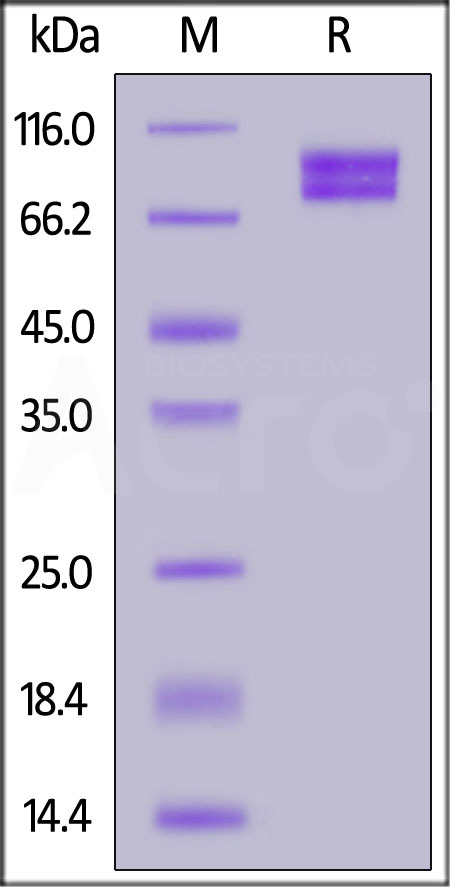
    The protein has a calculated MW of 61.5 kDa. The protein migrates as 80-110 kDa under reducing (R) condition (SDS-PAGE) due to glycosylation.

  • Endotoxin

    Less than 1.0 EU per μg by the LAL method / rFC method.

  • Purity

    >95% as determined by SDS-PAGE.

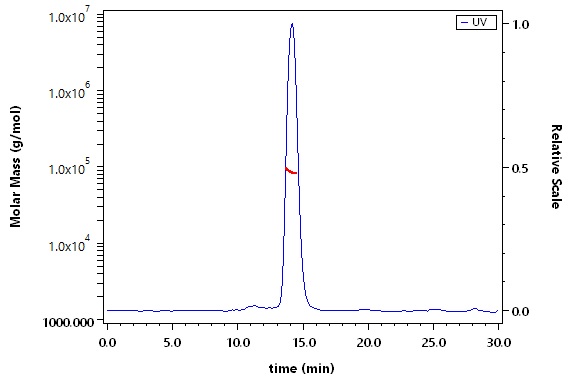
    >95% as determined by SEC-MALS.

  • Formulation

    Lyophilized from 0.22 μm filtered solution in PBS, pH7.4 with trehalose as protectant.

    Contact us for customized product form or formulation.

  • Reconstitution

    Please see Certificate of Analysis for specific instructions.

    For best performance, we strongly recommend you to follow the reconstitution protocol provided in the CoA.

  • Storage

    For long term storage, the product should be stored at lyophilized state at -20°C or lower.

    Please avoid repeated freeze-thaw cycles.

    This product is stable after storage at:
    1. -20°C to -70°C for 12 months in lyophilized state;
    2. -70°C for 3 months under sterile conditions after reconstitution.
  • ACRO Quality Management System

    1. QMS(ISO, GMP)
    2. Quality Advantages
    3. Quality Control Process

Background

CD146, also known as the melanoma cell adhesion molecule (MCAM) or cell surface glycoprotein MUC18, is a 113kDa cell adhesion molecule currently used as a marker for endothelial cell lineage. As a member of the Immunoglobulin superfamily, It is expressed on chicken embryonic spleen and thymus, activated human T cells, endothelial progenitors such as angioblasts and mesenchymal stem cells, and strongly expressed on blood vessel endothelium and smooth muscle.
CD146 has been demonstrated to appear on a small subset of T and B lymphocytes in the peripheral blood of healthy individuals. The CD146+ T cells display an immunophenotype consistent with effector memory cells and have a distinct gene profile from the CD146- T cells.
As a Ca2+ independent cell adhesion molecule involved in heterophilic cell to cell interactions and a surface receptor,CD146 triggers tyrosine phosphorylation of FYN and PTK2 and subsequently induced signal transduction, proteolysis or immune recognition.