

Product Details
Synonyms
PCSK9, FH3, HCHOLA3, LDLCQ1, NARC1, PC9
Source
Rat PCSK9, His Tag (PC9-R52H4) is expressed from human 293 cells (HEK293). It contains AA Gln 31 - Gln 691 (Accession # P59996-1).
Predicted N-terminus: Gln 31

Request for sequenceMolecular Characterization

Other Tags and Version Biotin & Other Labeled Version
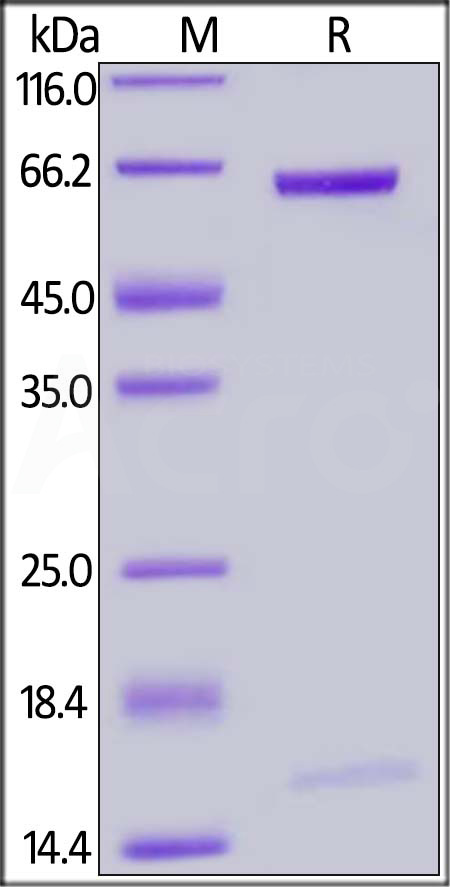
This protein carries a polyhistidine tag at the C-terminus. This protein undergoes autocatalytic cleavage to release the pro-peptide and mature chain. The pro-peptide and mature chain are associated through non‑covalent interactions and with a calculated MW of 13.9 kDa and 59.3 kDa respectively. The protein migrates as 16 kDa and 60-66 kDa under reducing (R) condition (SDS-PAGE) due to glycosylation.
Endotoxin
Less than 1.0 EU per μg by the LAL method / rFC method.
Purity
>95% as determined by SDS-PAGE.
Formulation
Lyophilized from 0.22 μm filtered solution in 50 mM Tris, 150 mM NaCl, pH7.5 with trehalose as protectant.
Contact us for customized product form or formulation.
Reconstitution
Please see Certificate of Analysis for specific instructions.
For best performance, we strongly recommend you to follow the reconstitution protocol provided in the CoA.
Storage
For long term storage, the product should be stored at lyophilized state at -20°C or lower.
Please avoid repeated freeze-thaw cycles.
This product is stable after storage at:
- -20°C to -70°C for 12 months in lyophilized state;
- -70°C for 3 months under sterile conditions after reconstitution.
ACRO Quality Management System
Customers Also Viewed
Performance Data
SDS-PAGE

Rat PCSK9, His Tag on SDS-PAGE under reducing (R) condition. The gel was stained with Coomassie Blue. The purity of the protein is greater than 95%.
Bioactivity-ELISA

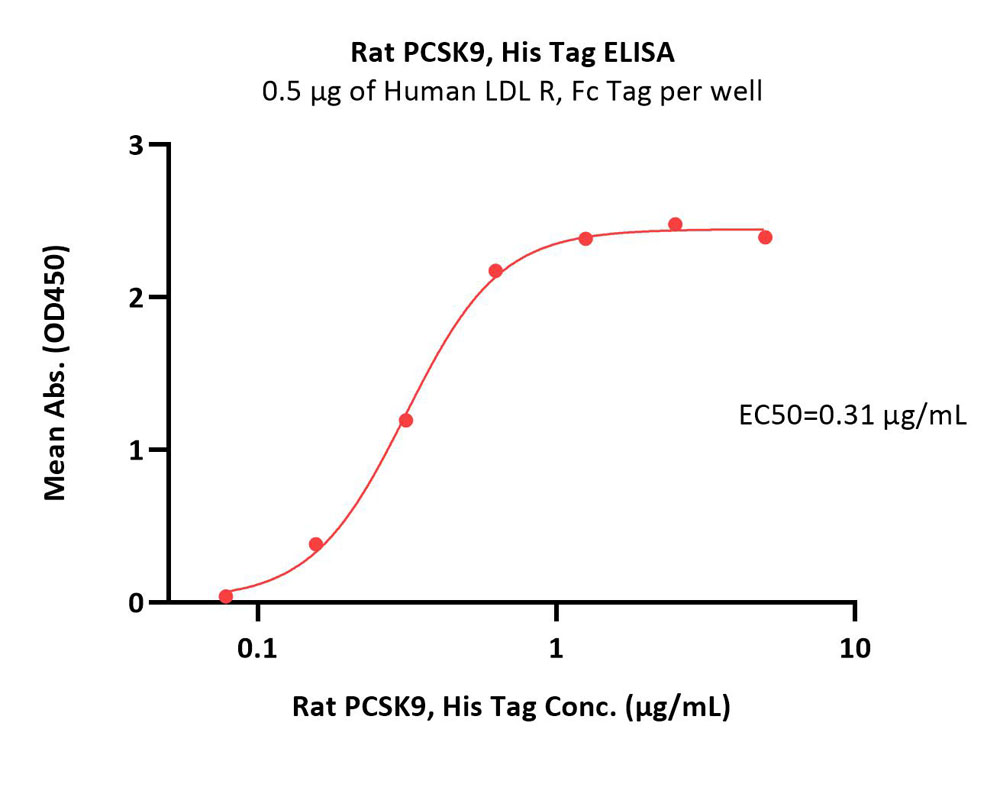
Immobilized Human LDL R, Fc Tag at 5 μg/mL (100 μL/well) can bind Rat PCSK9, His Tag (Cat. No. PC9-R52H4) with a linear range of 0.156-0.625 μg/mL (QC tested).
Protocol
Bioactivity-BLI

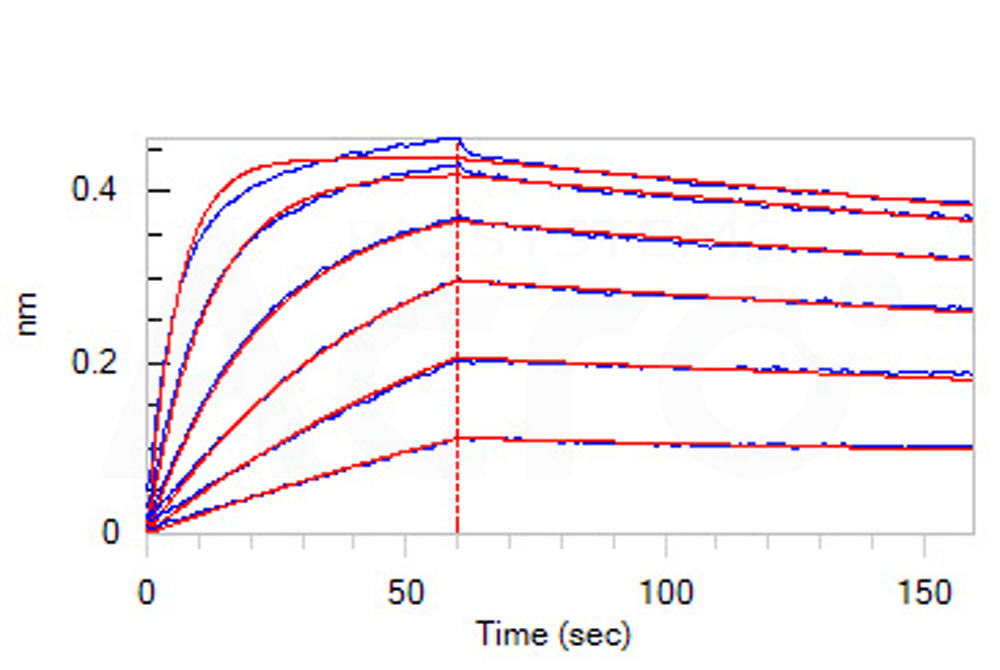
Loaded Human LDL R, Fc Tag on Protein A Biosensor, can bind Rat PCSK9, His Tag (Cat. No. PC9-R52H4) with an affinity constant of 1.61 nM as determined in BLI assay (ForteBio Octet Red96e) (Routinely tested).
Protocol
Customer Reviews Writing Reviews

FAQ
- Product
What key experimental conditions should be considered for PCSK9–LDLR binding assays?
It is recommended to perform PCSK9–LDLR binding assays under acidic conditions, as the interaction exhibits higher activity in acidic environments compared to neutral ones. Reference: Effects of pH and Low Density Lipoprotein (LDL) on PCSK9-dependent LDL Receptor Regulation.
Background
Recent Advances
- English Name:
Proprotein convertase subtilisin kexin type 9
- Category:
- Approved Drugs:
8 Details
- Drugs in Clinical Trials:
35 Details
- Highest Development Stage:
Approved