

Human Tau-441 (K18, P301L) Protein, Tag Free, low endotoxin (MALS verified)

AIDD‑Ready
Related Products: Cell line CHEK-ATP087
Numéro de produit/spécification
Prix
Availability
Qté
TAU-H5118-100ug
$290.00
In Stock - Delivery in 1-2 business days
TAU-H5118-1mg
$1,915.00
In Stock - Delivery in 1-2 business days
TAU-H5118
Montant du produit :
$ 0
0
Ajouter au panier
Suggestion de nouveau produit Request Quote
Contact Us
Contact Us
Montant du produit:
$ 0
0
Ajouter au panier
  • Détails du produit
  • Affichage des données
  • Reviews & Citations
  • Important Statement
  • Resources
Synonyms

DDPAC, FTDP-17, MAPT, MSTD, MTBT1, Tau, PHF-tau, TAU

Source

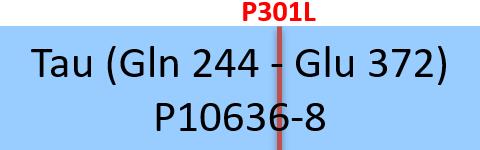
Human Tau-441 (K18, P301L) Protein, Tag Free (TAU-H5118) is expressed from E. coli cells. It contains AA Gln 244 - Glu 372 (Accession # P10636-8 (P301L)).

Predicted N-terminus: Met
Molecular Characterization

This protein carries no "tag".

The protein has a calculated MW of 13.8 kDa. The protein migrates as 14-15 kDa when calibrated against Star Ribbon Pre-stained Protein Marker under reducing (R) condition (SDS-PAGE).

Endotoxin

Less than 0.01 EU per μg by the LAL method / rFC method.

Purity

>95% as determined by SDS-PAGE.

Formulation

Supplied as 0.2 μm filtered solution in 20 mM Tris, 150 mM NaCl, pH7.5 with trehalose as protectant.

Contact us for customized product form or formulation.

Shipping and Storage

This product is supplied and shipped on dry ice.

Please avoid repeated freeze-thaw cycles.

This product is stable after storage at:
  • The product MUST be stored at -70°C or lower upon receipt;
  • -70°C for 3 months under sterile conditions.

Introduction de fond

Tau is a microtubule-associated protein, which encodes by the MAPT gene that located on chromosome 17q21. Tau Promotes microtubule assembly and stability, and might be involved in the establishment and maintenance of neuronal polarity. Hyperphosphorylation of the tau protein (tau inclusions, pTau) can result in the self-assembly of tangles of paired helical filaments and straight filaments, which are involved in the pathogenesis of Alzheimer's disease, frontotemporal dementia, and other tauopathies.
