

Mon panier

Monoclonal Anti-NMTi Antibody, Rabbit IgG (M1E05)

  • Antibody Internalization Detection Reagent (IGG-PZF2001) monitors endocytosis in live cells
Avis des utilisateurs
Numéro de produit/spécification
Prix
Qté
NMI-MY2365-100ug
$315.00
NMI-MY2365-1mg (500ug X 2)
$1890.00
ETA of in-stock products:2 business days
Total des articles Montant du produit$ 0

Détails du produit

  • Source

    Monoclonal Anti-NMTi Antibody, Rabbit IgG (M1E05) is a rabbit monoclonal antibody recombinantly expressed in HEK293 cells.

  • Antibody Type

    Recombinant Monoclonal

  • Clone

    M1E05

  • Isotype

    Rabbit IgG, Kappa

  • Host Species

    Rabbit

  • Immunogen

    NMTi-BSA

  • Specificity

    Specifically recognizes NMTi.

  • Purification

    Protein A purified / Protein G purified.

  • Concentration

    Please refer to the Certificate of Analysis (CoA).

  • Form

    Lyophilized

  • Formulation

    Lyophilized from a 0.22 μm-filtered solution in PBS (pH 7.4), with trehalose as protectant.

    Please contact us for customized product forms or formulations.

  • Reconstitution

    Please refer to the Certificate of Analysis (CoA) for specific instructions.

  • Shipping

    Lyophilized product is shipped at ambient temperature.

  • Storage

    For long term storage, the product should be stored in a lyophilized state at -20°C or lower.

    Please avoid repeated freeze-thaw cycles.

    This product is stable after storage at:

    1. -20°C to -70°C for 12 months in lyophilized state;
    2. -70°C for 3 months under sterile conditions after reconstitution.
  • Notices

    Product Specific Notices: For research use only.

  • ACRO Quality Management System

    1. QMS(ISO, GMP)
    2. Quality Advantages
    3. Quality Control Process

Les clients ont également consulté

Affichage des données

  • Bioactivity-ELISA

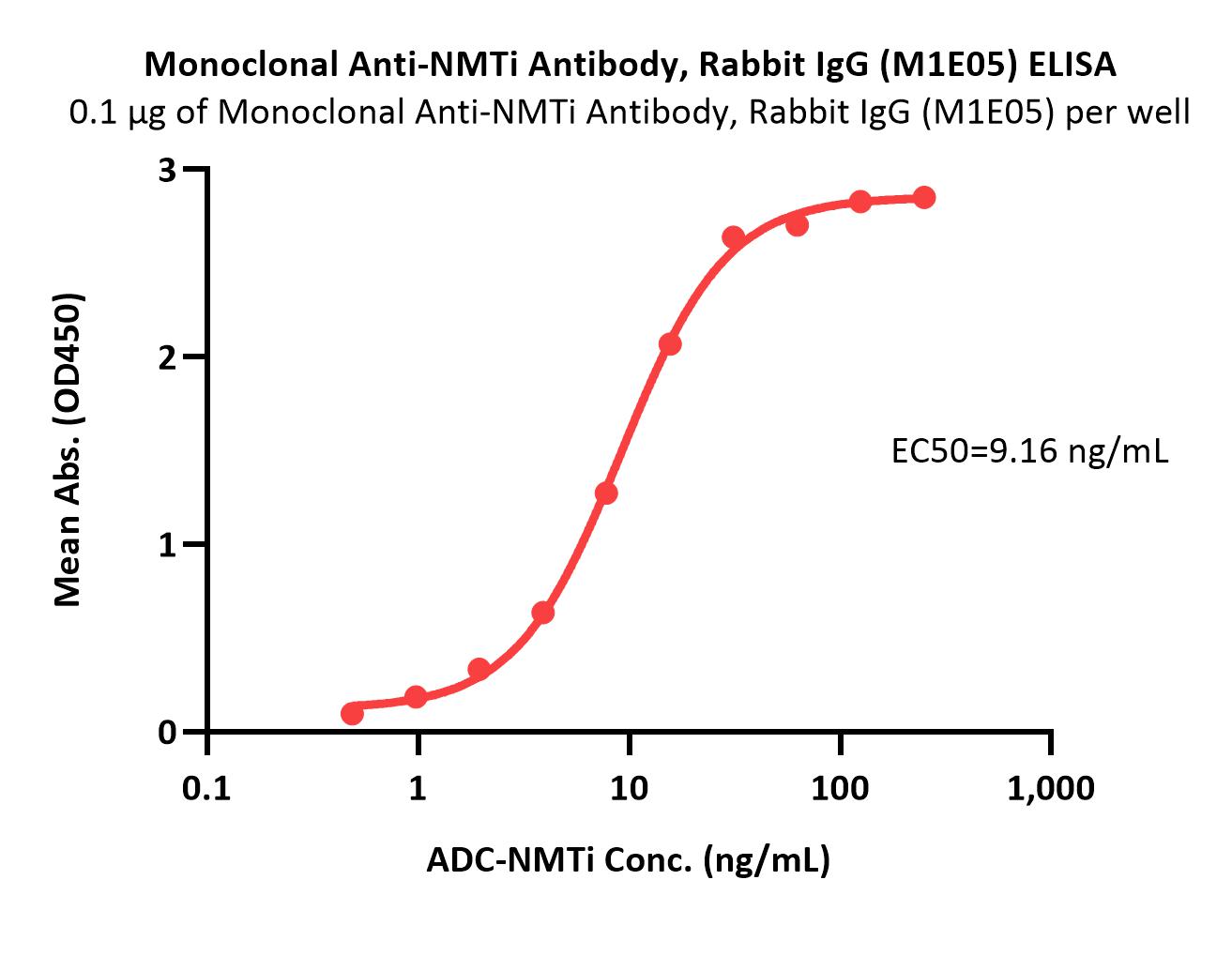
     NMTi ELISA

    Immobilized Monoclonal Anti-NMTi Antibody, Rabbit IgG (M1E05) (Cat. No. NMI-MY2365) at 1 μg/mL (100 μL/well) can bind ADC-NMTi with a linear range of 0.5-16 ng/mL (QC tested).

    Protocol
  •  NMTi ELISA

    Serial dilutions of NMTi, N-Myristoyltransferase inhibitor were added into Monoclonal Anti-NMTi Antibody, Rabbit IgG (M1E05) (Cat. No. NMI-MY2365): ADC-NMTi binding reactions. The half maximal inhibitory concentration (IC50) is 1.27 μg/mL (Routinely tested).

    Protocol
  • Cross Verification

     NMTi CROSS_VERIFICATION

    ELISA binding of Monoclonal Anti-NMTi Antibody, Rabbit IgG (M1E05) (Cat. No. NMI-MY2365) with ADC-NMTi, Trastuzumab Deruxtecan, Sacituzumab Govitecam, Disitamab Vedotin (RC48), DM1 Antibody Human IgG and IgG1-MMAF conjugated antibody respectively.
    The coating antibody was Monoclonal Anti-NMTi Antibody, Rabbit IgG (M1E05) (Cat. No. NMI-MY2365), used at 1 μg/mL concentration. The primary antibody were different payload conjugated antibodies, including ADC-NMTi, Trastuzumab Deruxtecan, Sacituzumab Govitecam, Disitamab Vedotin (RC48), DM1 Antibody Human IgG and IgG1-MMAF conjugated antibodies used at 0.5 μg/mL concentration. The secondary antibody was HRP conjugated Anti-Human-IgG-Fc Antibody (6F11C8), mAb (Acro, Cat. No. IGG-LY69) used at 1:10000 concentration.
    Monoclonal Anti-NMTi Antibody, Rabbit IgG (M1E05) (Cat. No. NMI-MY2365) is specific to ADC-NMTi, and has no cross-reactivity with Trastuzumab Deruxtecan, Sacituzumab Govitecam, Disitamab Vedotin (RC48), DM1 Antibody Human IgG and IgG1-MMAF (Routinely tested).

Avis des utilisateurs
Publier un commentaire

Introduction de fond

NMTi, a new ADC payload toxin developed by Myricx Bio, inhibits NMT to disrupt mitochondrial function and induce endoplasmic reticulum stress, thereby killing cancer cells. Its simple structure facilitates synthesis. In preclinical studies, it exhibits efficacy and safety in solid tumors; NMTi-ADCs feature dual targeting and strong bystander activity, and outperform T-Dxd in some models.

Progrès de frontière

 
Drug Candidate Licensing
More
  • Informations de base sur le produit
  • Détails du produit
  • Les clients ont également consulté
  • Affichage des données
  • Avis des utilisateurs
  • Contexte