Sep 3, 2026
 Page Views:548


Introduction
By mid-2026, the antibody-drug conjugate (ADC) field has reached a scale that few predicted just three years ago — yet the very success of established targets like HER2, TROP2, and Nectin-4 has created a new problem. Competition is intensifying, late-line monotherapy windows are narrowing, and the easy wins are behind us. Competition around established targets such as HER2, TROP2, and Nectin-4 continues to intensify, while opportunities in conventional late-line monotherapy are becoming more limited. As these target spaces become increasingly crowded, next-generation targets are expected to play a key role in shaping ADC development over the next three to five years.
Data presented at major conferences such as ASCO and AACR in 2026, together with recent clinical advances in ADC candidates and emerging technology platforms, point to a clear shift in the field. ADC development is moving beyond established targets toward new targets, novel target combinations, and advances in ADC technologies.
1. Emerging Targets in Solid Tumors: From Pan-Tumor Approaches to Difficult-to-Treat Cancers
As competition around established ADC targets intensifies, emerging targets may help address unmet treatment needs in difficult-to-treat cancers. Many of these targets combine high tumor expression with limited expression in normal tissues, providing a potential therapeutic window for ADC development.
1.1 B7-H3: The Broadest-Potential Target Across Solid Tumors
B7-H3 (CD276) is one of the most actively investigated emerging targets in ADC development. It is highly expressed in more than 70% of solid tumors, including esophageal squamous cell carcinoma, non-small cell lung cancer, breast cancer, glioblastoma, and prostate cancer, while showing low expression in normal adult tissues. This expression profile supports its development as an ADC target across multiple tumor types.
Several B7-H3 ADC programs in China reached key milestones in 2026. MHB088C has advanced to Phase III trials for small cell lung cancer and has shown promising early clinical data in multiple solid tumors including mCRPC. More than ten B7-H3 ADCs are currently in clinical development in China across solid and hematologic malignancies, with combinations involving immunotherapy also under investigation.
1.2 The Claudin Family: Unlocking Gastrointestinal Cancer Targets
Claudin 18.2 is an important target in gastric and pancreatic cancers. It is highly expressed in gastrointestinal tumors, while its expression in normal tissues is largely restricted to the gastric mucosal epithelium. IBI343 has progressed into Phase III clinical development (G-HOPE-001), while CMG901 has completed Phase I dose expansion with encouraging early data in gastric and GEJ cancers — both showing efficacy that compares favorably with conventional second-line therapies.
Claudin 6 is another emerging target with low expression in normal adult tissues and elevated expression in several cancers. Its potential is being explored in testicular, ovarian, and lung cancers.
1.3 DLL3: A Highly Selective Target for SCLC
Small cell lung cancer (SCLC) remains a difficult-to-treat malignancy with limited treatment options. DLL3, a ligand in the Notch signaling pathway, is highly expressed in more than 80% of SCLC tumors but shows minimal expression in normal lung tissue, making it a highly tumor-selective therapeutic target.
Zocilurtatug pelitecan achieved an objective response rate (ORR) of 66% in patients with SCLC and brain metastases (n=32, per data presented at AACR-NCI-EORTC 2025 by Zai Lab), with an ORR of 80% in patients without prior brain radiotherapy, demonstrating robust activity in this challenging patient population. DLL3 is also being explored in other neuroendocrine malignancies, including large-cell neuroendocrine carcinoma and neuroendocrine prostate cancer.
1.4 Niche Targets Opening Doors in Hepatocellular, Ovarian, and Other Cancers
Beyond broadly expressed targets, tumor-specific targets are creating new opportunities for ADC development in difficult-to-treat cancers. GPC3 (Glypican-3) is a target of interest in hepatocellular carcinoma, while CDH17 is being explored in gastric and colorectal cancers. FOLR1 (FRα) has been clinically validated in platinum-resistant ovarian cancer, and ROR1 is being investigated across both hematologic malignancies and solid tumors.
2. Bispecific ADCs: Solving Resistance, Heterogeneity, and Tumor Penetration
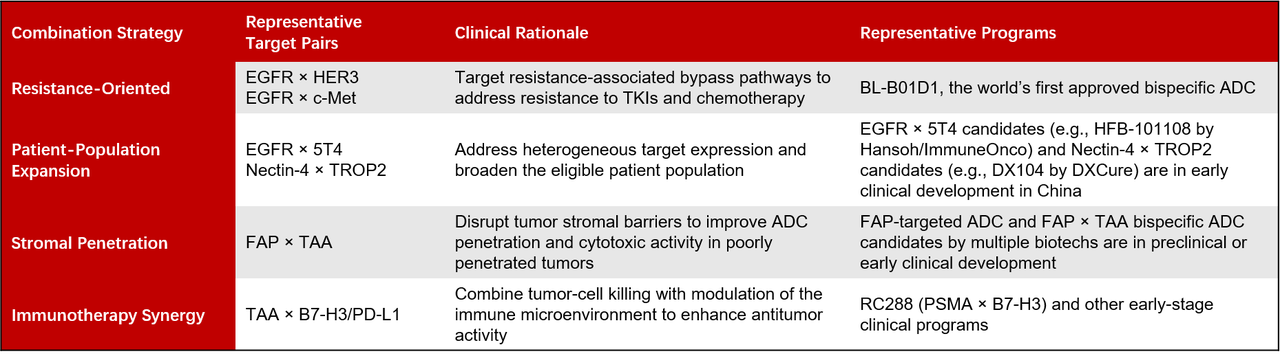
As competition among single-target ADCs intensifies, bispecific ADCs are emerging as a new direction for differentiation. BL-B01D1 (iza-bren), developed by Biokin Pharmaceutical, is expected to become the world's first approved bispecific ADC, with its NDA accepted by NMPA in late 2025 under priority review — marking an important milestone for dual-target ADC development. Rather than simply combining two targets, bispecific ADCs are designed to address specific clinical challenges, including drug resistance, heterogeneous target expression, limited tumor penetration, and immunosuppression in the tumor microenvironment.
3. Payload, Linker, and Conjugation: Technology as the New Differentiator
ADC development is no longer driven by target selection alone. Advances in payloads, linkers, and site-specific conjugation are expanding the range of targets and molecular designs that can be pursued, making these technologies increasingly important in ADC development.
3.1 Diversifying ADC Payloads
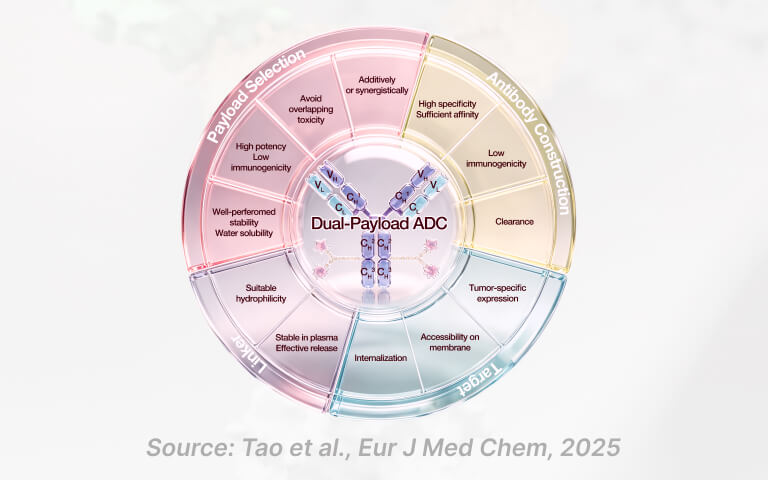
Topoisomerase inhibitor payloads such as DXd are now widely used, while next-generation payload strategies are expanding toward dual-payload and immune-stimulatory approaches. Dual-payload ADCs combine cytotoxic agents with different mechanisms of action to potentially address tumor resistance. Immune-stimulatory ADCs incorporate agents such as TLR or STING agonists to activate antitumor immune responses in addition to delivering targeted cytotoxicity.
3.2 Linker Design to Improve the Therapeutic Window
Tumor microenvironment-responsive linkers are designed to release payloads under tumor-associated conditions, such as acidic pH, reducing environments, or elevated protease activity. More selective payload release may reduce off-target toxicity and improve the therapeutic index, potentially expanding the range of targets suitable for ADC development.
3.3 Site-Specific Conjugation for Greater ADC Homogeneity
Compared with stochastic conjugation, site-specific conjugation enables more precise control of the drug-to-antibody ratio (DAR) and produces more homogeneous ADCs. This can improve stability and safety while supporting the development of high-potency and high-DAR ADCs.
4. Conclusion
After years of rapid growth, the ADC field is entering a new phase in which differentiation is becoming increasingly important. As opportunities around established targets become more limited, the next phase of ADC development will increasingly depend on identifying targets that address unmet clinical needs and pairing them with advances in ADC design and technology.
To support ADC research, ACROBiosystems offers a comprehensive range of products and services covering early discovery, CMC quality control, and both preclinical and clinical development. Our solutions help researchers accelerate innovation and optimize ADC design for maximum therapeutic impact.

Contact Us Today to explore our full range of ADC solutions