World Sjögren’s Day | Advancing Together with ACRO to Uncover the Truth Behind Dryness
 Date de publication :2025-07-24
 Nombre de vues :1707
Decoding the “Dry” Origin: An Immune Storm Within the Exocrine Glands
Sjögren’s Syndrome (SS) is a prevalent autoimmune disease primarily characterized by lymphocytic infiltration of exocrine glands, leading to hallmark symptoms of dry mouth and dry eyes. Beyond glandular involvement, 30%–40% of patients experience systemic complications affecting the kidneys, lungs, nervous system, and other organs.
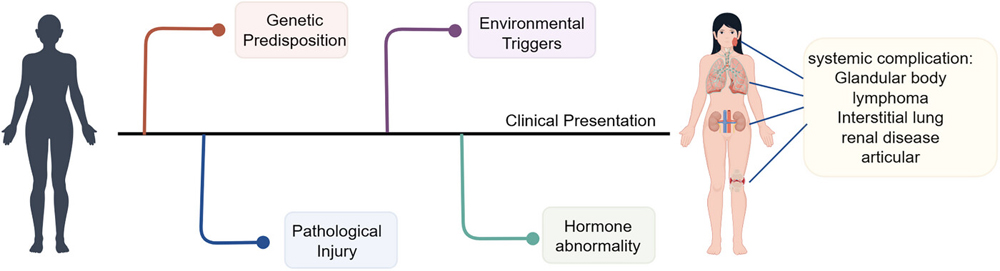
https://doi.org/10.1002/mco2.70297
The pathophysiological mechanisms of SS
The primary targets in SS are the exocrine glands—especially the salivary glands (SGs). Reduced saliva secretion is closely linked to persistent immune cell infiltration around salivary gland epithelial cells (SGECs) and progressive destruction of glandular architecture. Histopathological changes in SGs include extensive lymphocytic infiltration into the glandular stroma, significant damage and atrophy of SGECs, and alterations in glandular ducts such as dilation and narrowing, ultimately leading to SG injury. Chronic inflammation culminates in irreversible fibrosis of SGECs, marked by excessive deposition of connective tissue and extracellular matrix components—resulting in permanent loss of salivary gland function.
ACROBiosystems has developed a comprehensive product portfolio for SS research including highly active recombinant proteins, stable cell lines, and inhibitor screening kits. Our solutions span the entire drug development continuum – from target discovery and validation, candidate drug screening and development to CMC manufacturing and quality control – accelerating the efficient translation of SS innovative therapies from foundational research to clinical implementation.

Free download: ACRO's autoimmune disease drug development solutions!
Immune Storm in SS: How a Dysregulated Network Dismantles Glandular Vitality
SS is driven by autoimmune targeting of exocrine glands, primarily salivary and lacrimal glands. A hallmark of the disease is persistent activation of the type I interferon (IFN-I) pathway, leading to excessive IFN-α/β, enhanced antigen presentation, lymphocyte activation, and chronic inflammation. B cells are hyperactivated—marked by autoantibody production, hypergammaglobulinemia, and ectopic lymphoid structures—largely driven by elevated BAFF. CD4+T cells contribute through the release of proinflammatory cytokines (e.g., IL-17, IFN-γ), while Treg dysfunction impairs immune balance. Salivary gland epithelial cells actively participate by expressing MHC-II, secreting chemokines (e.g., CXCL12), cytokines (e.g., BAFF), and presenting antigens. Proinflammatory signaling (e.g., NF-κB) further amplifies inflammation. Cumulative immune attacks lead to glandular destruction and classic dryness symptoms. Preserving secretory function through better understanding of SS pathogenesis is vital for improving outcomes.
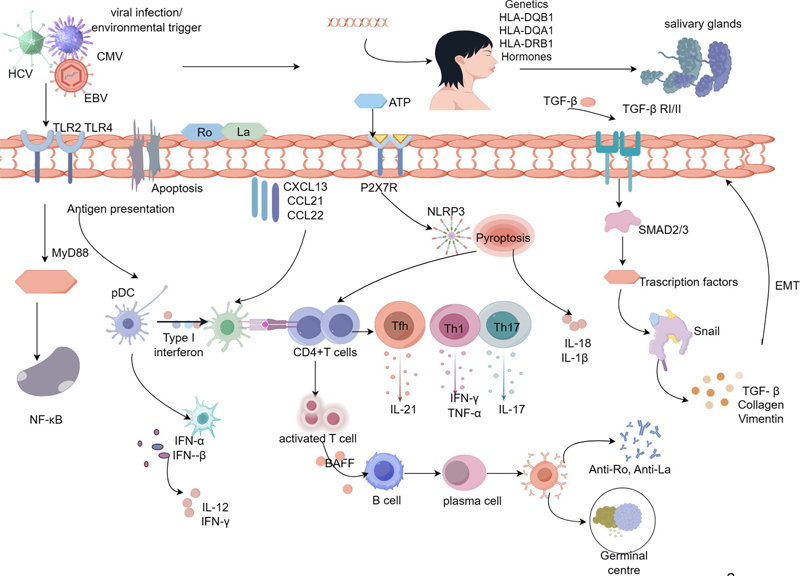
https://doi.org/10.3389/fimmu.2024.1405126
The pathological mechanisms of salivary gland damage in SS
Targeted Breakthroughs: A Global Landscape of Therapeutic Development in SS
As a chronic autoimmune disease, SS has witnessed notable progress in targeted therapies in recent years. Global pipelines are increasingly focused on key targets such as FCGRT, BAFF/APRIL, CD40/CD40L, and IFNAR1, with therapeutic modalities ranging from monoclonal and bispecific antibodies to fusion proteins and gene therapies. Among approved therapies, Argenx’s Efgartigimod alfa—the first-in-class FCGRT inhibitor—achieved blockbuster status with $1.2 billion in global sales in 2023 (primarily for myasthenia gravis). Its SS indication expansion is expected to drive further growth. AstraZeneca’s Anifrolumab, with $480 million in 2023 sales for lupus, is in Phase III trials for SS, leveraging its mechanism targeting the IFN-I pathway. Telitacicept, developed by Rongchang Bio, is the world’s first dual-target BAFF/APRIL inhibitor. With $73 million in china sales in 2023, its Phase III program positions it for entry into the SS market. Additionally, repurposed biologics such as Johnson & Johnson’s IL-12/IL-23 inhibitor Ustekinumab and Novartis/Roche’s anti-IgE antibody Omalizumab are being explored as novel treatment options for SS.
Advancements in SS Drug Development (Data Source: Pharmacodia)
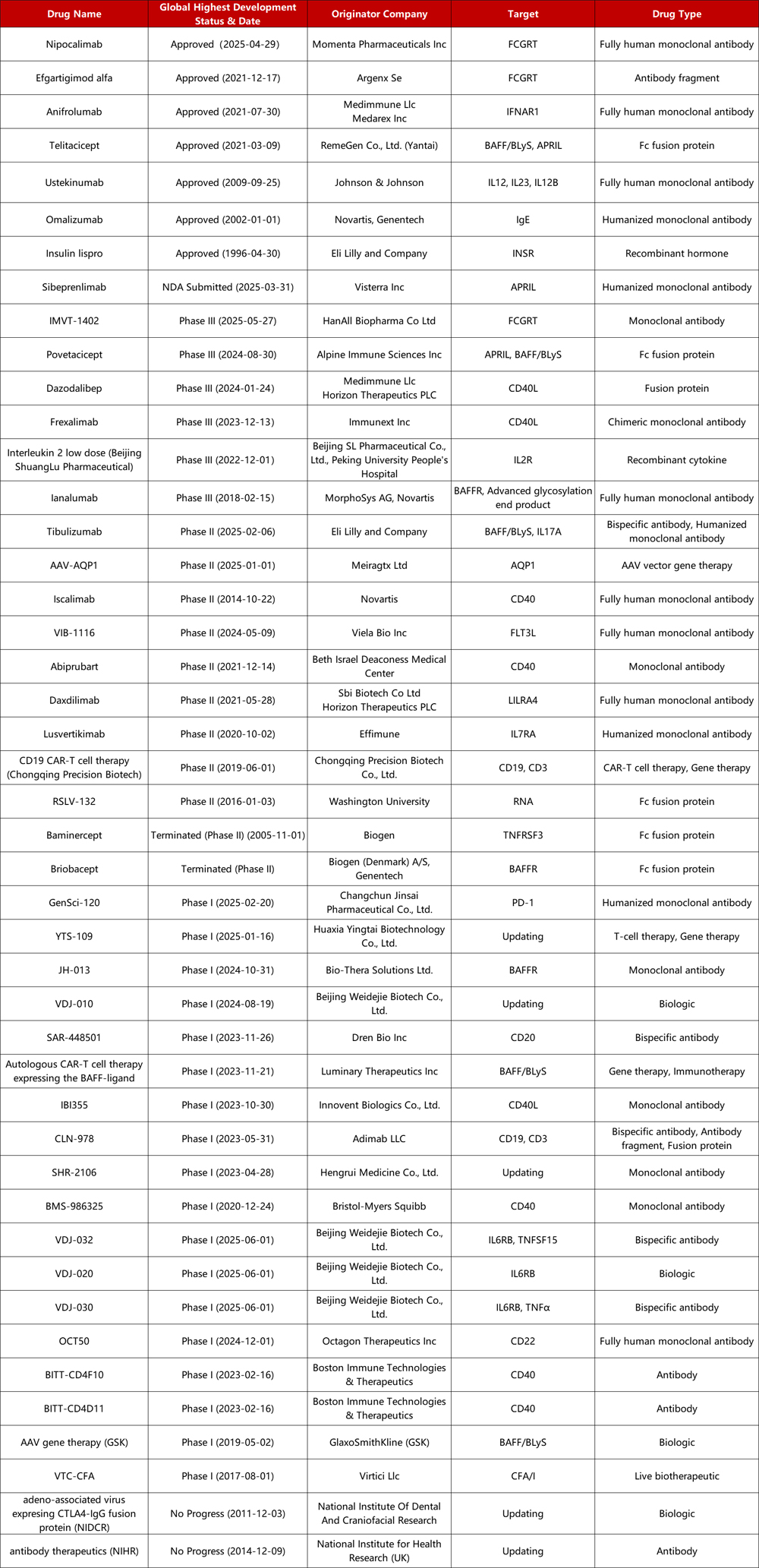
In terms of pipeline development, Nipocalimab and Sibeprenlimab—targeting FCGRT and APRIL respectively—have shown promising improvements in SS, suggesting their potential as next-generation standard therapies. Phase III candidates such as IMVT-1402, Povetacicept, and Dazodalibep are competing across targets including FCGRT, dual BAFF/APRIL, and the CD40/CD40L pathway. In the field of innovative technologies, the AAV-AQP1 gene therapy aims to restore salivary gland function by repairing aquaporin channels, while Chongqing Precision Bio’s CD19 CAR-T and Luminary’s BAFF-CAR-T represent cutting-edge advances in cell-based therapies.
ACROBiosystems Pioneers SS Therapeutics with Innovative Solutions
The pathogenic mechanisms of salivary gland damage in SS are complex, involving multifaceted interactions between cellular and molecular factors. Therefore, enhancing our understanding of these mechanisms and leveraging early research findings to prevent or mitigate further glandular injury is critical to improving patients’ quality of life.
ACROBiosystems has developed a comprehensive product portfolio for SS research including highly active recombinant proteins, stable cell lines, and inhibitor screening kits. Our solutions span the entire drug development continuum – from target discovery and validation, candidate drug screening and development to CMC manufacturing and quality control – accelerating the efficient translation of SS innovative therapies from foundational research to clinical implementation.
Free download: ACRO's autoimmune disease drug development solutions!
Hot SS Target Recommendations
Related Articles
>>World Ankylosing Spondylitis Day | ACRO Stands with You in Safeguarding Spinal Health
>>World Lupus Day | ACRO Stands with You in the Fight Against SLE
>>World Inflammatory Bowel Disease Day | ACRO Stands with You in Safeguarding Intestinal Health
>>World Myasthenia Gravis Day | ACRO Stands with You in Protecting Muscle Health

>> ComboX, A Combination of Universal Solutions
References
1. Hu Y, Wen B, Zhang Y, et al. Sjögren's Syndrome: Epidemiology, Classification Criteria, Molecular Pathogenesis, Diagnosis, and Treatment[J]. MedComm, 2025, 6(7): e70297. https://doi.org/10.1002/mco2.70297
2. Pavlidis K, Adamantidi T, Maria C, et al. Sjögren’s Syndrome and Ocular Inflammation: Pathophysiology, Clinical Manifestation andMitigation Strategies[J]. Immuno, 2025, 5(3): 24. https://doi.org/10.3390/immuno5030024
3. Qi W, Tian J, Wang G, et al. Advances in cellular and molecular pathways of salivary gland damage in Sjögren’s syndrome[J]. Frontiers in Immunology, 2024, 15: 1405126. https://doi.org/10.3389/fimmu.2024.1405126
4. Tian Y, Yang H, Liu N, et al. Advances in pathogenesis of Sjögren’s syndrome[J]. Journal of immunology research, 2021, 2021(1): 5928232. https://doi.org/10.1155/2021/5928232
 Articles populairesRecommandations associéesActivités populaires
 Why CAR-T Works in Blood Cancers but Struggles in Solid Tumors2026-05-27Nombre de vues :11
 Universal CAR Detection Solutions: Broad Compatibility, Higher Efficiency!2026-05-25Nombre de vues :20
 Comprehensive Guide to CAR-T Targets in Solid and Hematologic Malignancies2026-05-21Nombre de vues :155
 Bispecific Antibody Lanscape: Evolution, Breakthroughs, and Prospects2026-05-21Nombre de vues :149
 CD19 as a CAR-T Target: Biology, Limitations, and Alternative Strategies2026-05-20Nombre de vues :126




 Produits associés