Human-Monkey Cross-Reactivity: A Cornerstone for Safer and More Effective T-Cell Engager Development
 Publication Date:2025-07-31
 Page Views:3159
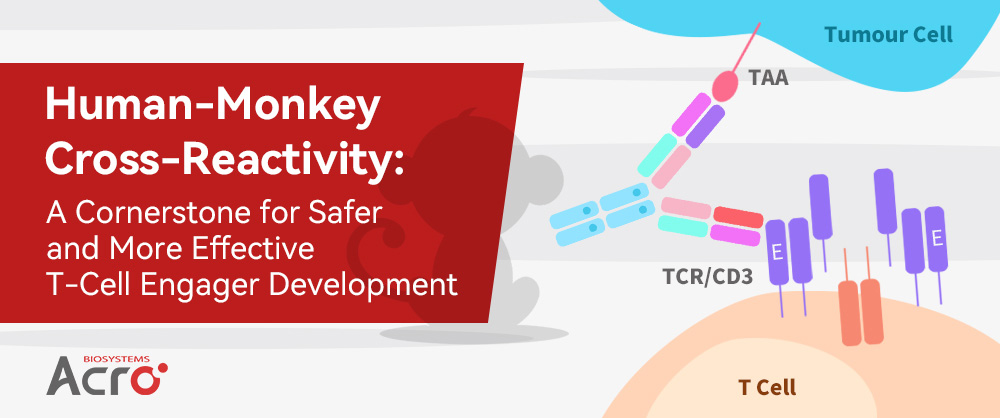
TCEs: Redefining Precision Immunotherapy
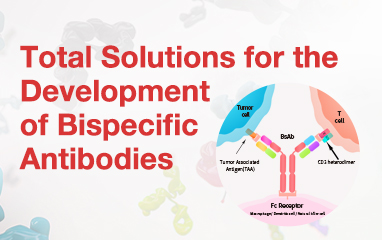
T-cell engager (TCE) therapy represents a major advancement in biomedicine, offering transformative potential for treating both autoimmune diseases and cancer. In autoimmune disorders, TCEs act as "immune navigation systems," precisely modulating overactive T cells and providing new therapeutic hope for conditions like rheumatoid arthritis and type 1 diabetes. In oncology, TCEs utilize bispecific or multispecific binding—targeting tumor-associated antigens and CD3 on T cells—to redirect immune responses specifically to tumor sites, driving significant breakthroughs in treating hematologic malignancies and solid tumors.
Challenges in TCE Development: Balancing Efficacy and Safety
Despite their promise in cancer treatment, TCEs face critical challenges:
- On-target, off-tumor toxicity: The ideal TCE target is a tumor-specific antigen. However, if the antigen is also expressed at low levels in normal tissues, TCEs may redirect T cells to attack healthy cells, leading to severe adverse effects.
- Cytokine release syndrome (CRS): Rapid and excessive activation of T cells by TCEs can trigger a cytokine storm—including IL-6, IFN-γ, and TNF-α—causing life-threatening symptoms such as high fever and hypotension.
- Narrow therapeutic window: TCEs must maintain antitumor efficacy while minimizing toxicity, resulting in an extremely limited effective dosage range.
Consequently, accurately predicting TCE efficacy, pharmacokinetics, and toxicity profiles—particularly CRS risk—in preclinical models directly determines candidate drug success. Establishing animal models that authentically replicate human immune responses has become a critical requirement for TCE development.
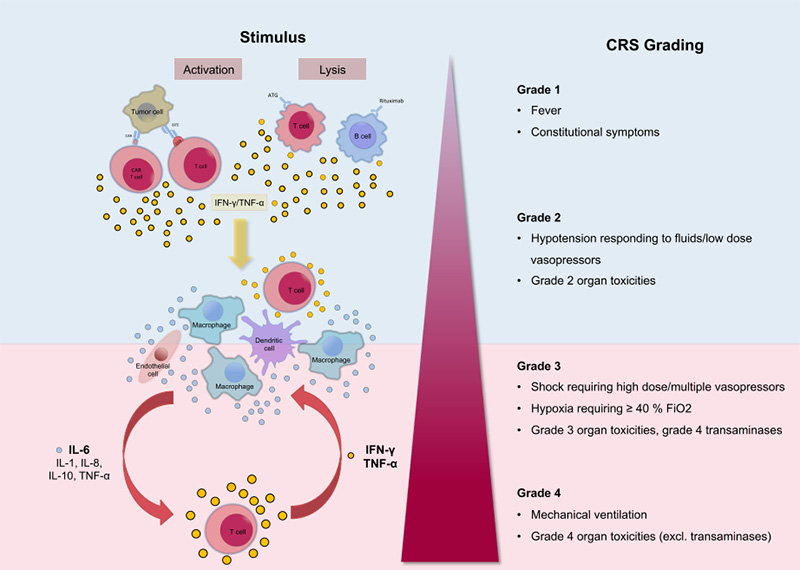
https://doi.org/10.1186/s40425-018-0343-9
Mechanism of CRS
The Critical Role of Human-Monkey Cross-Reactivity in TCE Development
Animal studies are crucial for validating TCE efficacy and safety. As a phylogenetically close model to humans, cynomolgus monkeys exhibit high similarity to humans in the amino acid sequence, spatial structure, and biological function of their CD3 protein. This characteristic makes them a key factor in selecting appropriate experimental models.
Recent research published by Chugai Pharmaceutical in the Journal of Applied Toxicology underscores the unique value of the monkey model in TCE safety studies. The study revealed that ERY22 (GPC3/CD3 TCE), a candidate drug targeting GPC3-positive solid tumors, exhibited a distinct dose-response profile in cynomolgus monkeys: a single intravenous dose of 1000 μg/kg triggered fatal CRS, whereas a stepwise dose-escalation regimen (1→3→10→30→100→300→1000 μg/kg) effectively prevented CRS while preserving partial tumor-killing activity. This research not only highlights the unique advantages of the monkey model in verifying human-monkey cross-reactivity but also provides a scientific basis for optimizing TCE dosing strategies, thereby facilitating the safety design of anti-tumor TCE drugs.
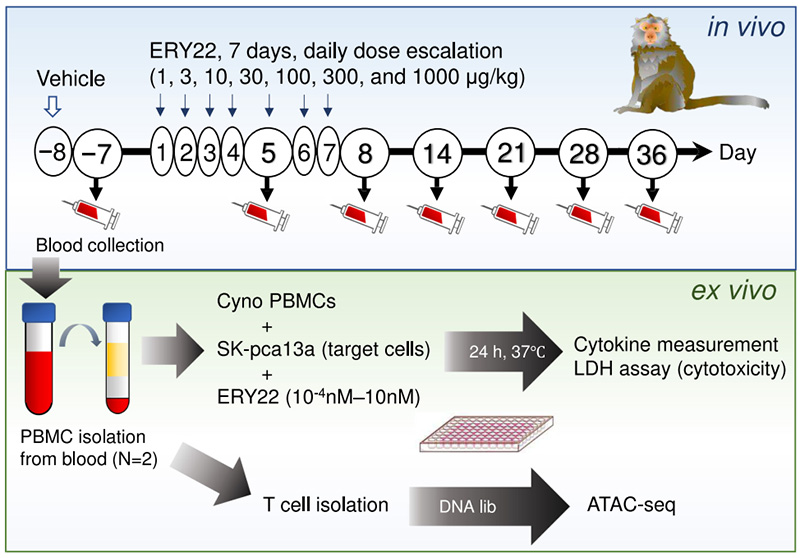
https://doi.org/10.1002/jat.4812
Experimental Scheme of Escalating ERY22 Dosing in Cynomolgus Monkey Model
High-Quality Cynomolgus CD3 Protein Facilitates Innovative TCE Drug Development
High-quality cynomolgus CD3 protein enables accurate assessment of human-monkey cross-reactivity for TCEs, enabling the selection of relevant animal models and accelerating non-clinical accelerating evaluation. We offer high-quality cynomolgus monkey CD3 proteins, including CD3E & CD3D and CD3E & CD3G heterodimers, as well as CD3 epsilon and CD3 delta monomers. The CD3E&CD3D and CD3E&CD3G heterodimers are verified via non-reducing electrophoresis and MALS as genuine 1:1 heterodimer, ensuring protein purity and homogeneity. Additionally, our CD3 proteins have undergone comprehensive binding activity validation with various TCEs (e.g., CD3×BCMA, CD3×CD20, CD3×DLL3) and clinical bispecific antibodies, supporting TCE drug screening and optimization to accelerate the development of innovative therapies.
Molecule list
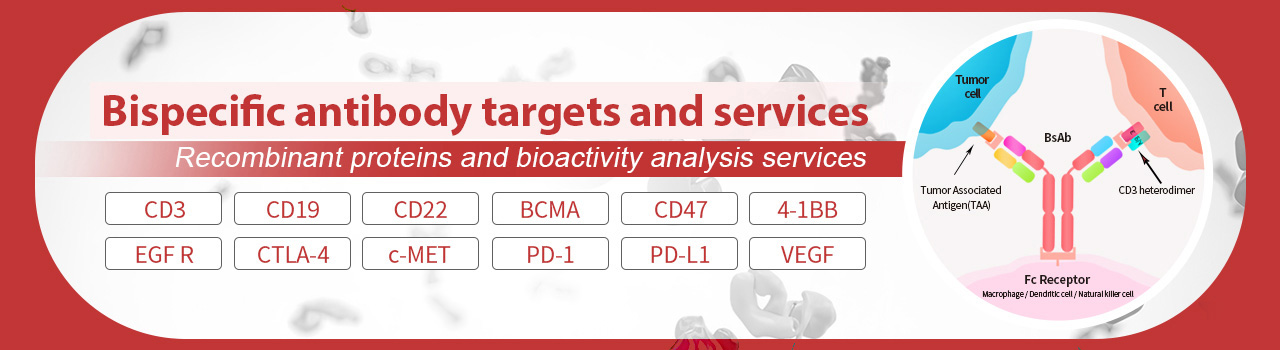
>> Learn More About Our Bispecific Antibody Targets and Services
Reference
1. Shimabukuro-Vornhagen A, Gödel P, Subklewe M, et al. Cytokine release syndrome[J]. Journal for immunotherapy of cancer, 2018, 6: 1-14. https://doi.org/10.1186/s40425-018-0343-9
2. Iwata Y, Matsushita T, Narushima Y, et al. Antitumor Cytotoxic Activity Retained in Tolerized T Cells Following Daily Dose Escalation of a T‐Cell Engager in Cynomolgus Monkeys to Mitigate Cytokine Release Syndrome[J]. Journal of Applied Toxicology, 2025. https://doi.org/10.1002/jat.4812
 Popular ArticlesRelated RecommendationsPopular Events
 Why CAR-T Works in Blood Cancers but Struggles in Solid Tumors2026-05-27Page Views:13
 Universal CAR Detection Solutions: Broad Compatibility, Higher Efficiency!2026-05-25Page Views:25
 Comprehensive Guide to CAR-T Targets in Solid and Hematologic Malignancies2026-05-21Page Views:157
 Bispecific Antibody Lanscape: Evolution, Breakthroughs, and Prospects2026-05-21Page Views:153
 CD19 as a CAR-T Target: Biology, Limitations, and Alternative Strategies2026-05-20Page Views:128





 Related Products