Collectionner le produit

Détails du produit
Synonyms
MET, AUTS9, HGFR, RCCP2, c-Met
Source
Human HGF R, His Tag (MET-H5227) is expressed from human 293 cells (HEK293). It contains AA Glu 25 - Thr 932 (Accession # P08581-1).
Predicted N-terminus: Glu 25
Request for sequenceMolecular Characterization

Other Tags and Version Biotin & Other Labeled Version
This protein carries a polyhistidine tag at the C-terminus. The mature form of HGFR is a disulfide-linked heterodimer composed of proteolytically cleaved α and β chain. Each α and β chain has a calculated MW of 32.5 kDa and 70.2 kDa. The protein migrates as 40-45 kDa and 85-90 kDa when calibrated against Star Ribbon Pre-stained Protein Marker under reducing (R) condition (SDS-PAGE) due to glycosylation.
Endotoxin
Less than 0.01 EU per μg by the LAL method / rFC method.
Purity
>90% as determined by SDS-PAGE.
>95% as determined by SEC-MALS.
Formulation
Lyophilized from 0.22 μm filtered solution in PBS, pH7.4 with trehalose as protectant.
Contact us for customized product form or formulation.
Reconstitution
Please see Certificate of Analysis for specific instructions.
For best performance, we strongly recommend you to follow the reconstitution protocol provided in the CoA.
Storage
For long term storage, the product should be stored at lyophilized state at -20°C or lower.
Please avoid repeated freeze-thaw cycles.
This product is stable after storage at:
- -20°C to -70°C for 12 months in lyophilized state;
- -70°C for 3 months under sterile conditions after reconstitution.
ACRO Quality Management System
Les clients ont également consulté
Affichage des données
SDS-PAGE
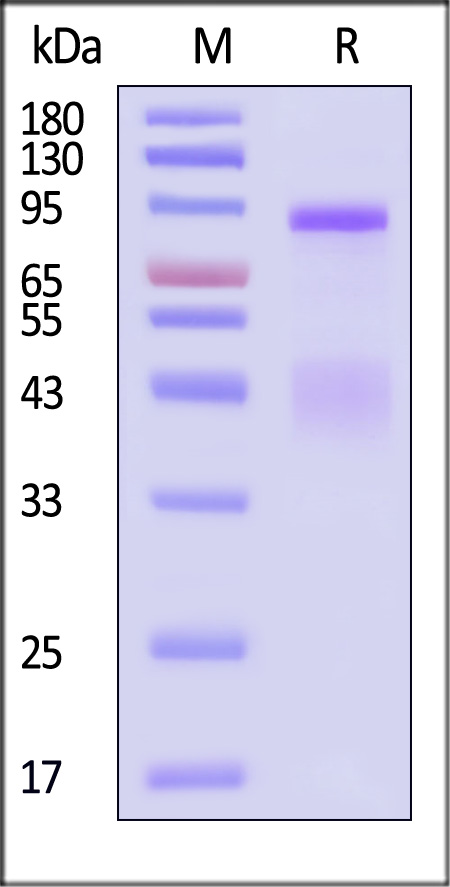
Human HGF R, His Tag on SDS-PAGE under reducing (R) condition. The gel was stained with Coomassie Blue. The purity of the protein is greater than 90% (With Star Ribbon Pre-stained Protein Marker).
SEC-MALS
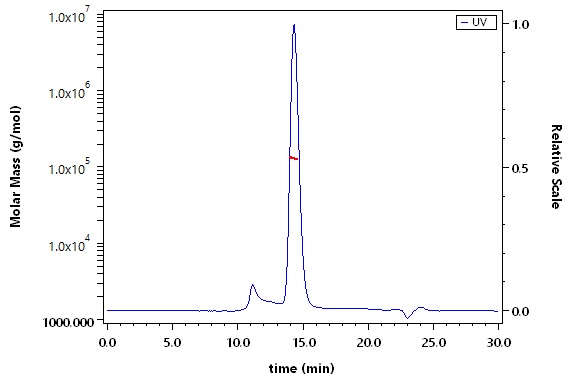
The purity of Human HGF R, His Tag (Cat. No. MET-H5227) is more than 95% and the molecular weight of this protein is around 100-140 kDa verified by SEC-MALS.
Report
Bioactivity-ELISA
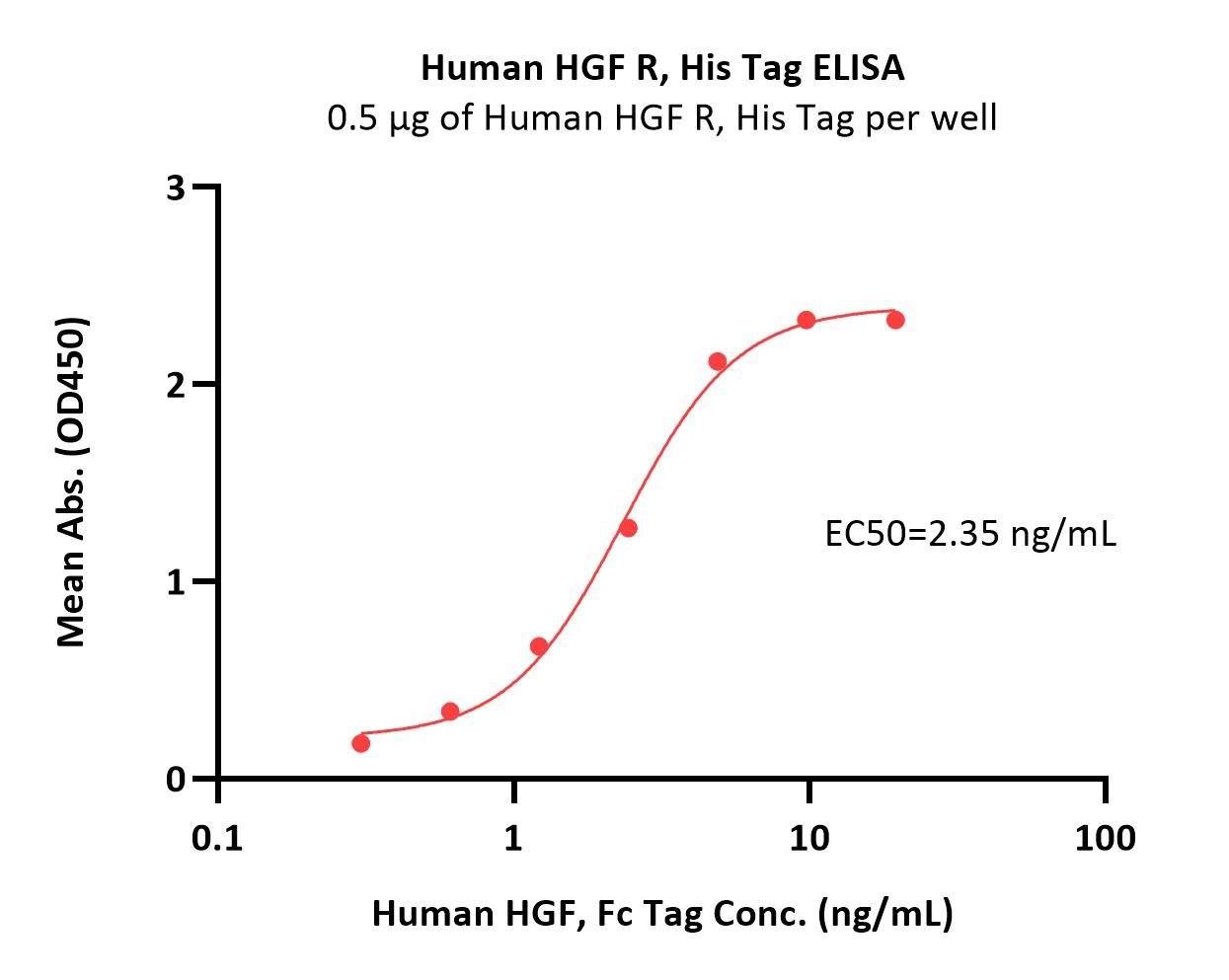
Immobilized Human HGF R, His Tag (Cat. No. MET-H5227) at 5 μg/mL (100 μL/well) can bind Human HGF, Fc Tag (Cat. No. HGF-H5253) with a linear range of 0.3-5 ng/mL (QC tested).
Protocol
Bioactivity-TR-FRET
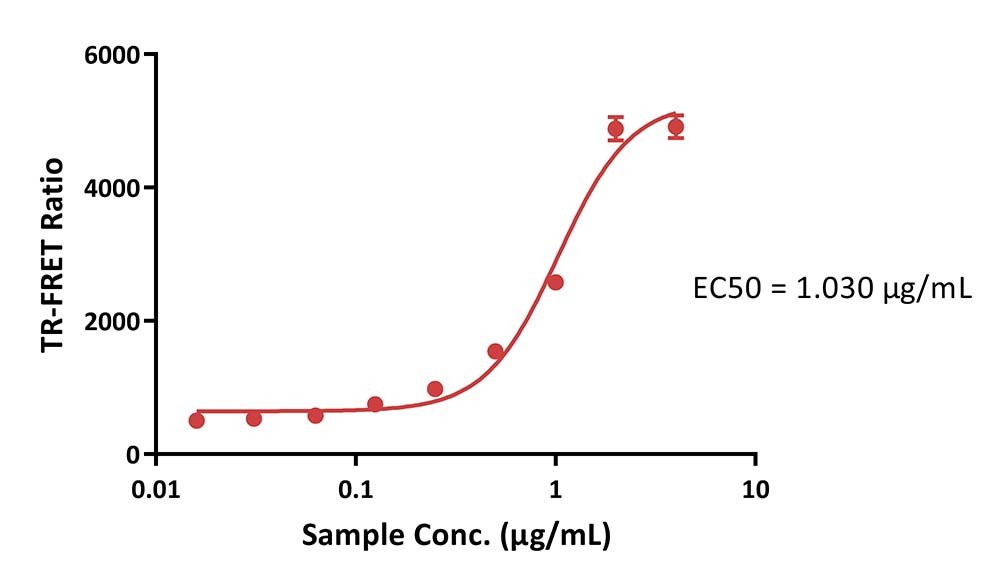
In this TR-FRET assay, Streptavidin Protein Europium chelate (for TR-FRET) (Cat. No. FRT-TD09) is used as the Donor and Monoclonal Anti-His Tag Antibody, Rabbit IgG FA-Labeled (for TR-FRET) (Cat. No. FRT-TA11) is used as the Acceptor. Human HGF R, His Tag (Cat. No. MET-H5227), at 10 ng/well and Biotinylated Human EGF R, Fc,Avitag (Cat. No. EGR-H82F8), at 10 ng/well, can bind to the Amivantamab with a linear detection range of 4-0.016 μg/mL (Routinely tested).
Bridging ELISA
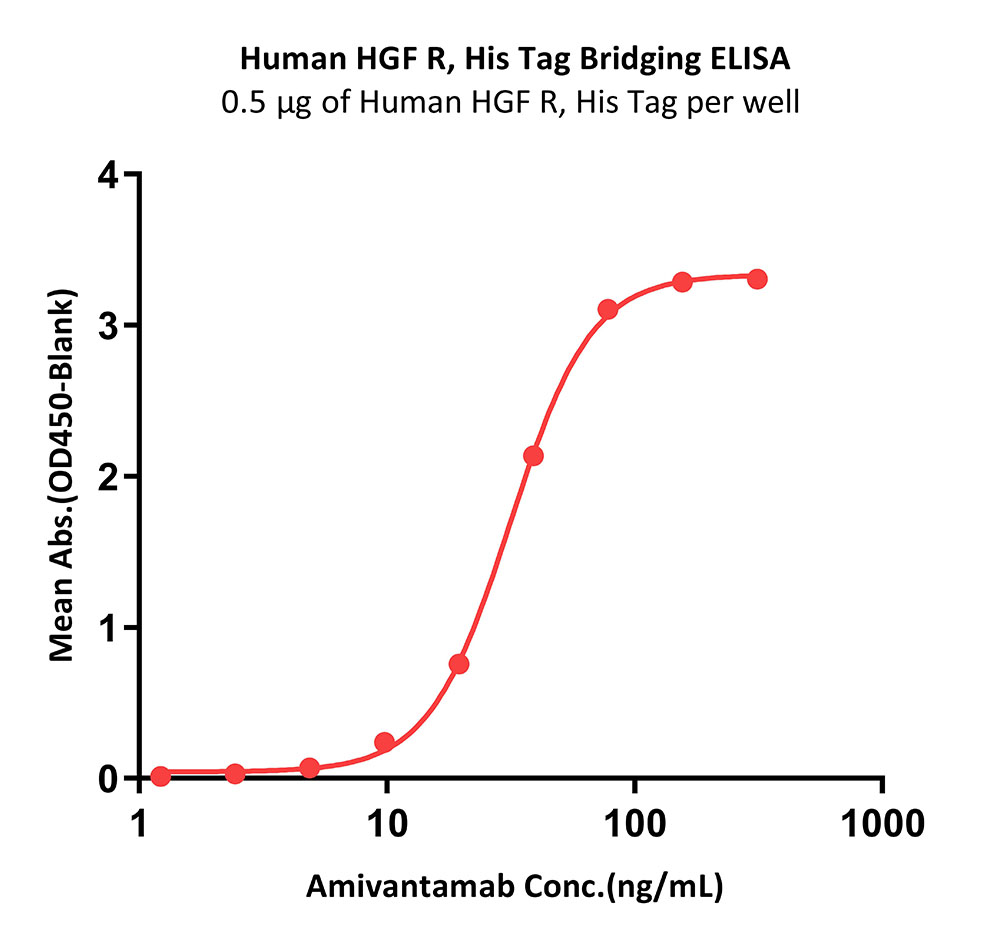
Validated with Bispecific Antibody.
Immobilized Human HGF R Protein, His Tag (Cat. No. MET-H5227) at 5 μg/mL, add increasing concentrations of Amivantamab and then add Biotinylated Human EGF R Protein, His,Avitag (Cat. No. EGR-H82E3) at 5 μg/mL. Detection was performed using HRP-conjugated streptavidin with sensitivity of 4.88 ng/mL (Routinely tested).
Avis des utilisateurs Publier un commentaire
 N***o2022-05-24
 J'aimeThe c-MET protein was delivered on time and we were able to use this protein for ELISA screening. I was able to get really good results from using this protein and would come back to Acrobiosystems to reorder this protein or order other proteins that I will need for future experiments.
Introduction de fond
Progrès de frontière
 Progrès du développement médicamenteux
- Nom anglais:
Hepatocyte growth factor receptor
- Catégorie:
- Nombre de médicaments répertoriés:
13 Détails
- Nombre de médicaments cliniques:
74 Détails
- Étape de développement la plus élevée:
Approved
 Contact Us


 Drug Candidate Licensing