Collectionner le produit

Détails du produit
Synonyms
IGF-I, IGF1A, somatomedin C, MGF
Source
Biotinylated Human IGF-I, His,Avitag (IG1-H82Q6) is expressed from human 293 cells (HEK293). It contains AA Gly 49 - Ala 118 (Accession # P05019-1).
Predicted N-terminus: His
Request for sequenceMolecular Characterization

Other Tags and Version Biotin & Other Labeled Version
This protein carries a polyhistidine tag at the N-terminus, followed by an Avi tag (Avitag™).
The protein has a calculated MW of 11.2 kDa. The protein migrates as 14 kDa under reducing (R) condition (SDS-PAGE) due to glycosylation.
Labeling
Biotinylation of this product is performed using Avitag™ technology. Briefly, the single lysine residue in the Avitag is enzymatically labeled with biotin.
Protein Ratio
Passed as determined by the HABA assay / binding ELISA.
Purity
>90% as determined by SDS-PAGE.
Formulation
Lyophilized from 0.22 μm filtered solution in PBS, pH7.4 with trehalose as protectant.
Contact us for customized product form or formulation.
Reconstitution
Please see Certificate of Analysis for specific instructions.
For best performance, we strongly recommend you to follow the reconstitution protocol provided in the CoA.
Storage
For long term storage, the product should be stored at lyophilized state at -20°C or lower.
Please avoid repeated freeze-thaw cycles.
This product is stable after storage at:
- -20°C to -70°C for 12 months in lyophilized state;
- -70°C for 3 months under sterile conditions after reconstitution.
ACRO Quality Management System
Les clients ont également consulté
Affichage des données
SDS-PAGE

Biotinylated Human IGF-I, His,Avitag on SDS-PAGE under reducing (R) condition. The gel was stained with Coomassie Blue. The purity of the protein is greater than 90%.
Bioactivity-ELISA

Immobilized Human IGF-I R, Fc Tag (Cat. No. IGR-H5253) at 5 μg/mL (100 μL/well) can bind Biotinylated Human IGF-I, His,Avitag (Cat. No. IG1-H82Q6) with a linear range of 10-78 ng/mL (Routinely tested).
Protocol
Bioactivity-SPR

Human IGF-I R, His Tag (Cat. No. IGR-H5229) immobilized on CM5 Chip can bind Biotinylated Human IGF-I, His,Avitag (Cat. No. IG1-H82Q6) with an affinity constant of 68 nM as determined in a SPR assay (Biacore 8K) (QC tested).
Protocol
Bioactivity-CELL BASE
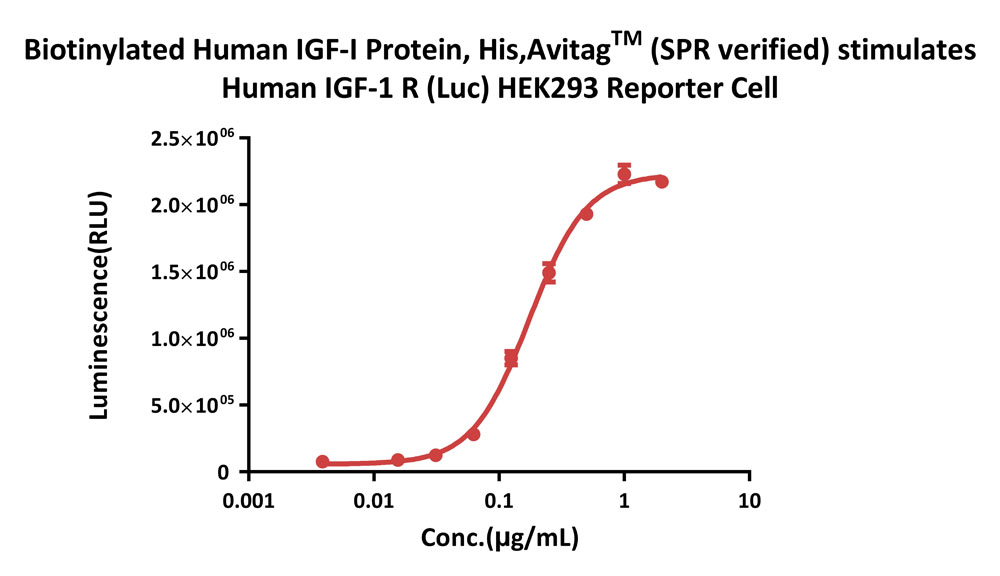
Biotinylated Human IGF-I Protein, His,Avitag™ (SPR verified) (Cat. No. IG1-H82Q6) stimulates Human IGF-1 R (Luc) HEK293 Reporter Cell. The EC50 for this effect is 0.1746 µg/mL (Routinely tested).
Protocol
Avis des utilisateurs Publier un commentaire

Introduction de fond
Progrès de frontière
 Progrès du développement médicamenteux
- Nom anglais:
Insulin-like growth factor I
- Catégorie:
- Nombre de médicaments répertoriés:
0 Détails
- Nombre de médicaments cliniques:
9 Détails
- Étape de développement la plus élevée:
Phase 3 Clinical
 Contact Us


 Drug Candidate Licensing