Collectionner le produit

Détails du produit
Application
- Cell based assay (FACS or functional assay)
- Affinity testing (SPR / BLI)
- Screening (ELISA)
Synonyms
MSP1D1
Source
Nanodisc FITC-Labeled Human MSP1D1 Protein, His Tag is expressed from E. coli system. It contains AA Gly 1 - Gln 211. It is the FITC labeled form of Human MSP1D1 Protein, His Tag.
Predicted N-terminus: Met
Request for sequenceMolecular Characterization
This protein carries a polyhistidine tag at the N-terminus. The protein has a calculated MW of 24.7 kDa. The protein migrates as 20-30 kDa when calibrated against Star Ribbon Pre-stained Protein Marker under reducing (R) condition (SDS-PAGE). This protein is used together with nanodisc protein as isotype control.
Structure
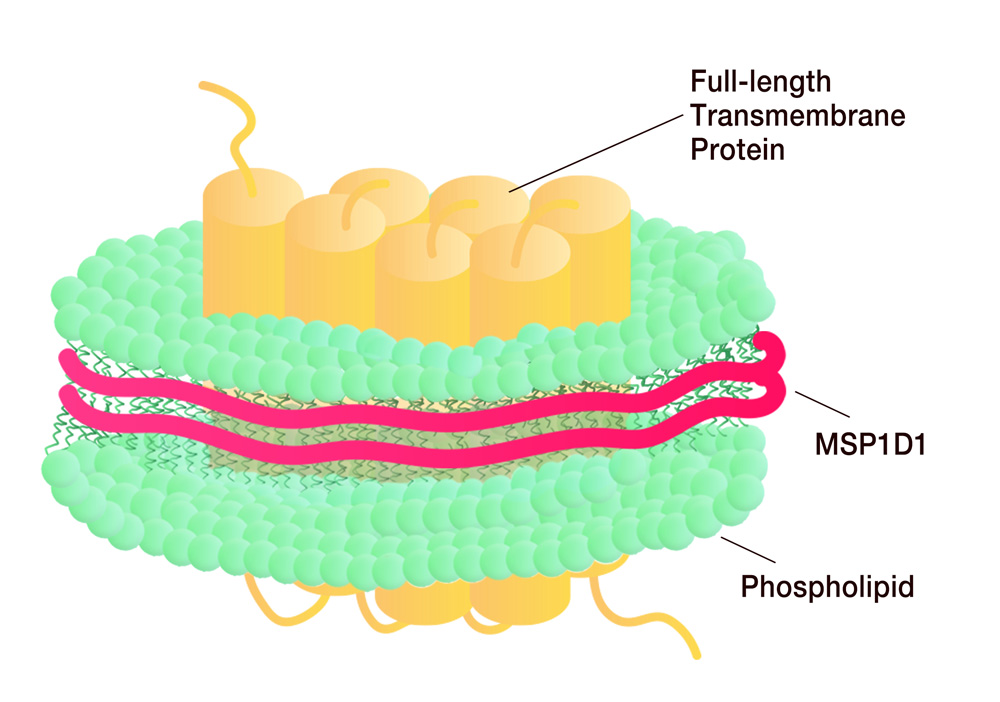
Nanodisc membrane protein is wrapped by a synthetic phospholipid bilayer membrane structure, composed of membrane scaffold proteins (MSPs) and phospholipids.
Synthesis Process

Nanodisc reconstitution is a self-assembly process that starts from purified, detergent-solubilized membrane proteins and reconstitutes them into synthetic phospholipid bilayers stabilized by MSP1D1 membrane scaffold protein. This creates a stable, detergent-free environment that preserves native conformation and biological activity, with excellent homogeneity and full compatibility with cell-based assays such as FACS and binding assays in antibody discovery and screening (ELISA),etc.
Conjugate
FITC
Excitation source: 488 nm spectral line, argon-ion laser
Excitation Wavelength: 488 nm
Emission Wavelength: 535 nm
Labeling
The primary amines in the side chains of lysine residues and the N-terminus of the protein are conjugated with FITC using standard chemical labeling method. The residual FITC is removed by molecular sieve treatment during purification process.
Purity
>90% as determined by SDS-PAGE.
Formulation
Supplied as 0.2 μm filtered solution in 20 mM HEPES, 150 mM NaCl, pH7.5 with trehalose as protectant.
Contact us for customized product form or formulation.
Shipping and Storage
This product is supplied and shipped on dry ice.
Please protect from light and avoid repeated freeze-thaw cycles.
This product is stable after storage at:
- The product MUST be stored at -70°C or lower upon receipt;
- -70°C for 12 months under sterile conditions.
ACRO Quality Management System
Les clients ont également consulté
Affichage des données
SDS-PAGE

FITC-Labeled Human MSP1D1 Protein, His Tag on SDS-PAGE under reducing (R) condition. The gel was stained with Coomassie Blue. The purity of the protein is greater than 90% (With Star Ribbon Pre-stained Protein Marker).
Bioactivity-FACS

2e5 of Anti-CD20 (ofatumumab) CAR-293 cells were stained with 100 μL of 1 μg/mL of FITC-Labeled Human MSP1D1 Protein, His Tag (Nanodisc) (Cat. No. APC-HF1H3) and positive control protein respectively. FITC signal was used to evaluate the non-specificity activity (QC tested).
Protocol
Avis des utilisateurs Publier un commentaire

 Contact Us


 Drug Candidate Licensing