Save Product

Product Details
Synonyms
CD33 antigen-like 3, SIGLEC-15, CD33L3, sialic acid-binding Ig-like lectin 15, Siglec15, Siglec-15
Source
Rhesus macaque Siglec-15 Protein, His Tag (SG5-C52H6) is expressed from human 293 cells (HEK293). It contains AA Phe 20 - Thr 263 (Accession # F7ETM4).
Predicted N-terminus: Phe 20
Request for sequenceMolecular Characterization

Other Tags and Version Biotin & Other Labeled Version
This protein carries a polyhistidine tag at the C-terminus.
The protein has a calculated MW of 28.1 kDa. The protein migrates as 30-40 kDa under reducing (R) condition (SDS-PAGE) due to glycosylation.
Endotoxin
Less than 1.0 EU per μg by the LAL method / rFC method.
Purity
>90% as determined by SDS-PAGE.
Formulation
Lyophilized from 0.22 μm filtered solution in PBS with Arginine, pH7.4 with trehalose as protectant.
Contact us for customized product form or formulation.
Reconstitution
Please see Certificate of Analysis for specific instructions.
For best performance, we strongly recommend you to follow the reconstitution protocol provided in the CoA.
Storage
For long term storage, the product should be stored at lyophilized state at -20°C or lower.
Please avoid repeated freeze-thaw cycles.
This product is stable after storage at:
- -20°C to -70°C for 12 months in lyophilized state;
- -70°C for 3 months under sterile conditions after reconstitution.
ACRO Quality Management System
Customers Also Viewed
Performance Data
SDS-PAGE
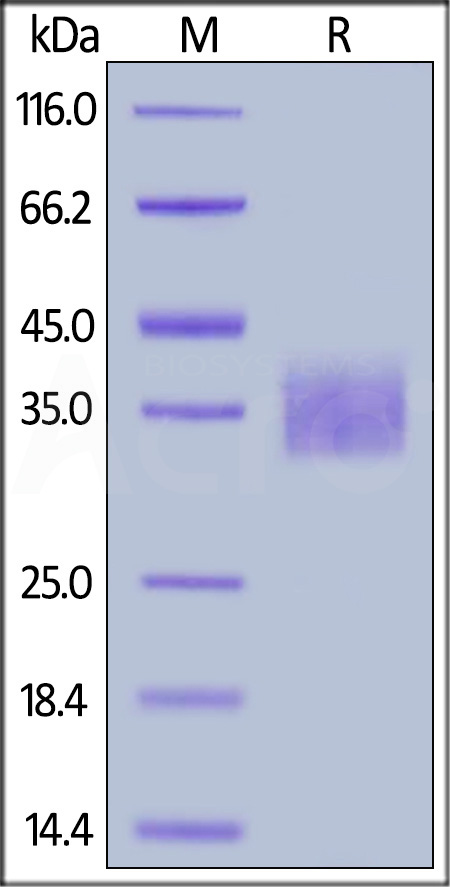
Rhesus macaque Siglec-15 Protein, His Tag on SDS-PAGE under reducing (R) condition. The gel was stained with Coomassie Blue. The purity of the protein is greater than 90%.
Bioactivity-ELISA

Immobilized Rhesus macaque Siglec-15, His Tag (Cat. No. SG5-C52H6) at 5 μg/mL (100 μL/well) can bind Mouse Human chimeric MAb (5G12, Human IgG1) with a linear range of 0.3-2 ng/mL (QC tested).
Protocol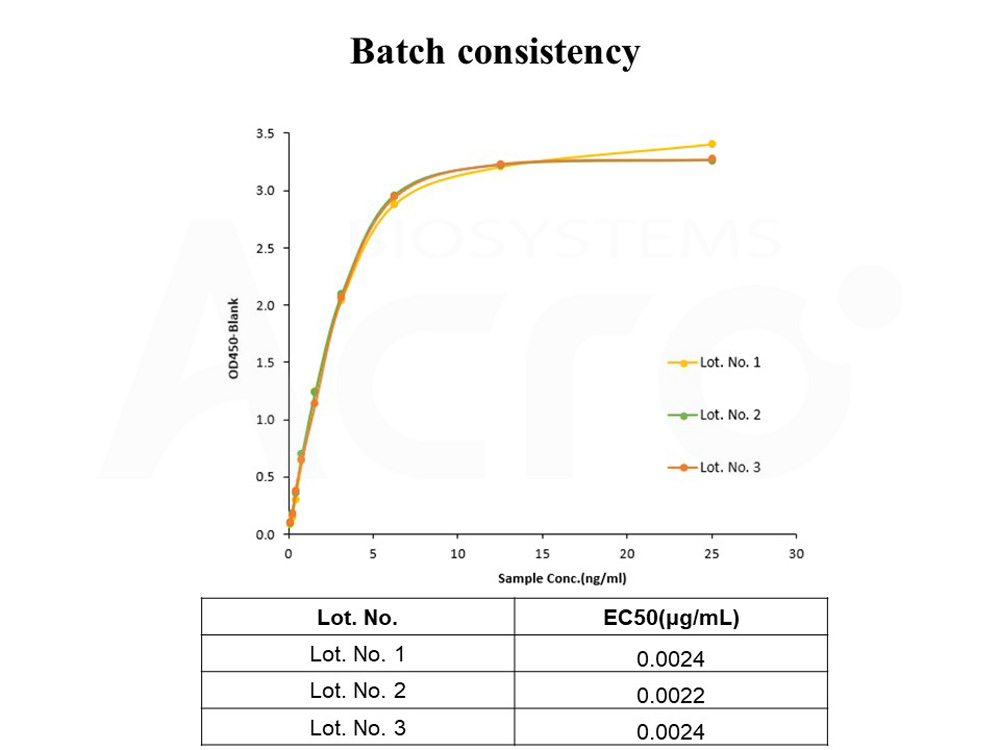
Customer Reviews Writing Reviews

Background
Recent Advances
 Drug Development Progress
- English Name:
Sialic acid-binding Ig-like lectin 15
- Category:
- Approved Drugs:
0 Details
- Drugs in Clinical Trials:
3 Details
- Highest Development Stage:
Phase 2 Clinical
 Contact Us


 Drug Candidate Licensing