



Blood-Brain Barrier (BBB)-Targeted Drug Delivery Key Targets & Research Tools
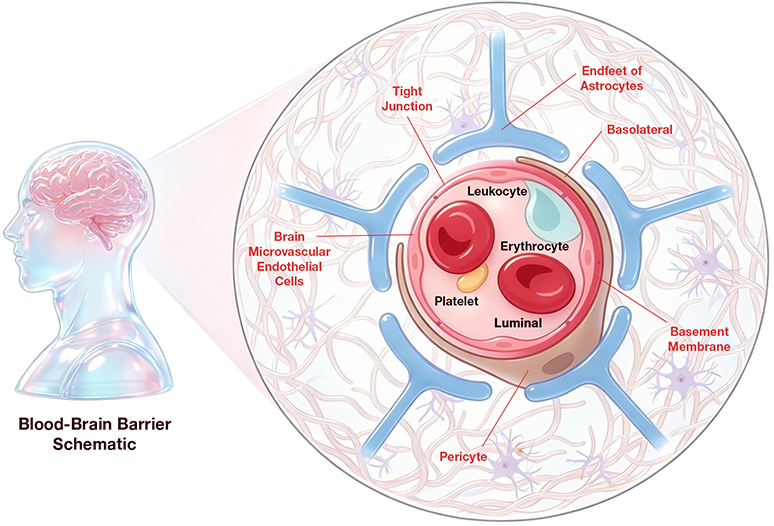
Schematic diagram of BBB structure
CMT mediates the trans-BBB permeation of nutrients such as glucose, amino acids, and certain ions. While inherently limited in accommodating large biomolecules, CMT can still be harnessed through structural mimicry or conjugation strategies. Among these, SLC2A1 (GLUT1) stands out as a prominent target for developing brain delivery approaches based on CMT.
Beyond RMT and CMT, some targets do not directly mediate BBB translocation; instead, they boost CNS drug exposure by modulating BBB integrity, the local pathological microenvironment, or drug clearance—CD147 serves as a representative example of this category.
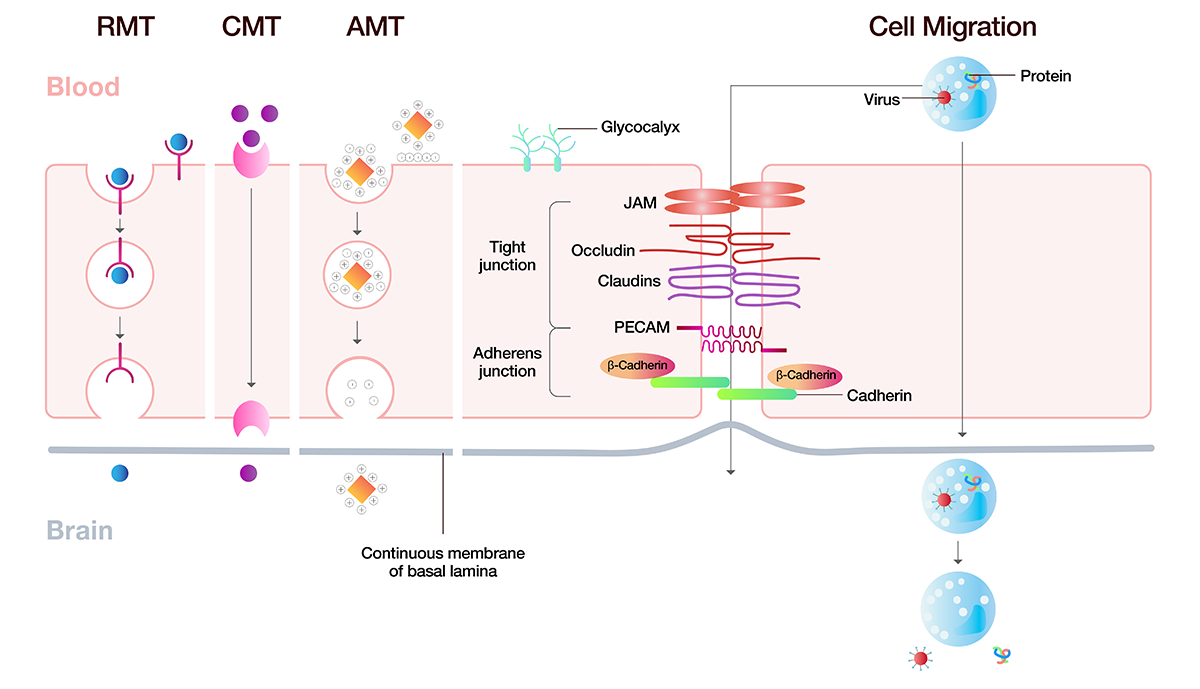
Biological transport mechanisms for crossing the BBB
Featured Products
Transferrin R (TfR1/CD71) is highly expressed on brain capillary endothelial cells, specifically binding diferric transferrin to form complexes that enter cells through clathrin-mediated endocytosis. Endosomal acidification liberates iron, and empty TfR1 recycles back to the cell membrane for continuous transport. This natural recycling pathway enables efficient BBB transcytosis of therapeutics modified with TfR1 antibodies or ligands. Since TfR1 is far more abundant in brain endothelium than in peripheral tissues, it serves as a “natural gateway” for CNS drug delivery, combining strong selectivity with efficient trans-barrier translocation. As such, TfR1 has emerged as one of the most mature BBB-penetrating targets, with multiple anti-TfR antibody–based brain-targeted formulations now advancing through clinical trials.
Validation Data of TfR1 Proteins
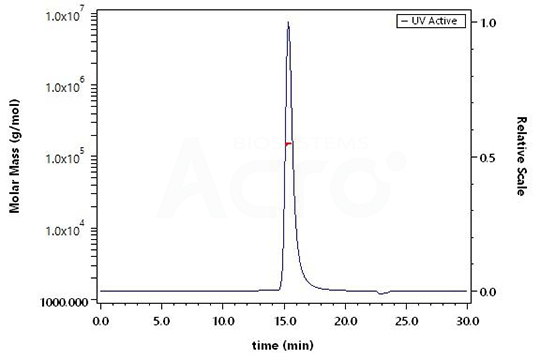
The purity of Human Transferrin R, His Tag (Cat. No. CD1-H5243)is more than 95% and the molecular weight of this protein is around 145-180 kDa verified by SEC-MALS.
Request Report
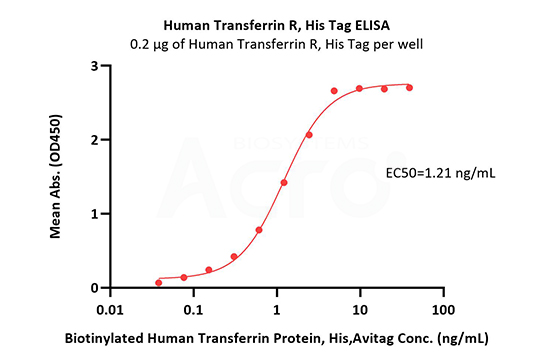
Immobilized Human Transferrin R, His Tag (Cat. No. CD1-H5243) at 2 μg/mL (100 μL/well) can bind Biotinylated Human Transferrin Protein, His,Avitag (Cat. No. TRN-H82E3) with a linear range of 0.04-2 ng/mL (QC tested).
Request Protocol
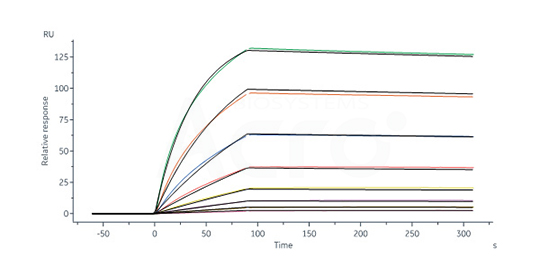
Captured Monoclonal Anti-CD71 Antibody, Mouse IgG1 (5B5) (Cat. No. CD1-MY2101) on CM5 chip via anti-mouse antibodies surface can bind Human Transferrin R, His Tag (Cat. No. CD1-H5243) with an affinity constant of 0.821 nM as determined in a SPR assay (Biacore 8K) (Routinely tested).
Request Protocol
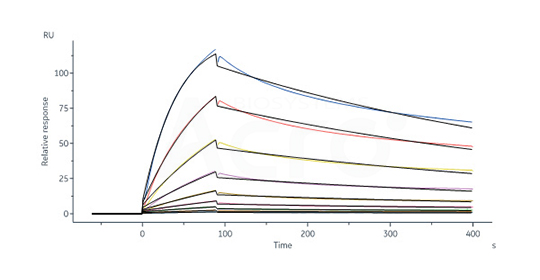
Trontinemab captured on Protein A Chip can bind Human Transferrin R, His Tag (Cat. No. CD1-H5243) with an affinity constant of 33.6 nM as determined in a SPR assay (Biacore 8K) (Routinely tested).
Request Protocol
Validation Data of TfR1 Functional Cell Lines
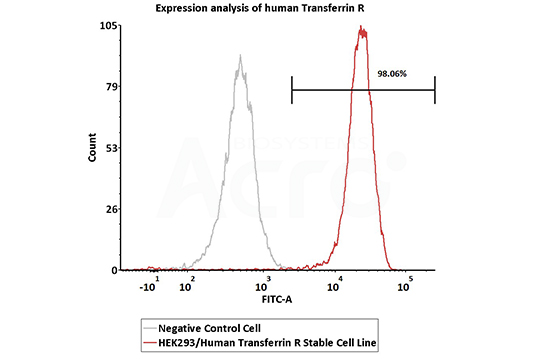
Expression analysis of human Transferrin R on HEK293/Human Transferrin R Stable Cell Line by FACS. Cell surface staining was performed on HEK293/Human Transferrin R Stable Cell Line (Cat. No. CHEK-ATP089) or negative control cell using FITC-Labeled anti-Transferrin Receptor Antibody.
Request Protocol
Validation Data of TfR1 TR-FRET Kit
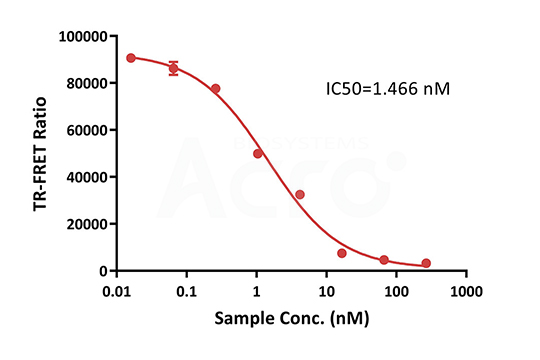
In this TR-FRET assay, Human Transferrin Protein Europium-chelate is used as the Donor and FA Labeled Human Transferrin R is used as the Acceptor. An inhibition Assay was performed to evaluate the interaction between human transferrin and human transferrin R using Human Transferrin Protein resulting in a typical IC50 of 1.466 nM (QC tested).
Recommended Neuroscience Targets
Resources
Brochure download
References
1. Gong Z, Zhou D, Wu D, et al. Challenges and material innovations in drug delivery to central nervous system tumors[J]. Biomaterials, 2025, 319: 123180. https://doi.org/10.1016/j.biomaterials.2025.123180
2. Terstappen G C, Meyer A H, Bell R D, et al. Strategies for delivering therapeutics across the blood–brain barrier[J]. Nature Reviews Drug Discovery, 2021, 20(5): 362-383. https://doi.org/10.1038/s41573-021-00139-y
- Background
- Featured Products
- Recommended Neuroscience Targets
- Resources
- References